In large factories, warehouses, or sports arenas, the slowly rotating giant blades of industrial fans always bring a sense of steady power. But a truly high-quality fan has much more value than just being able to blow air. It is backed by a rigorous engineering system that emphasizes safety, efficiency, and lifespan.
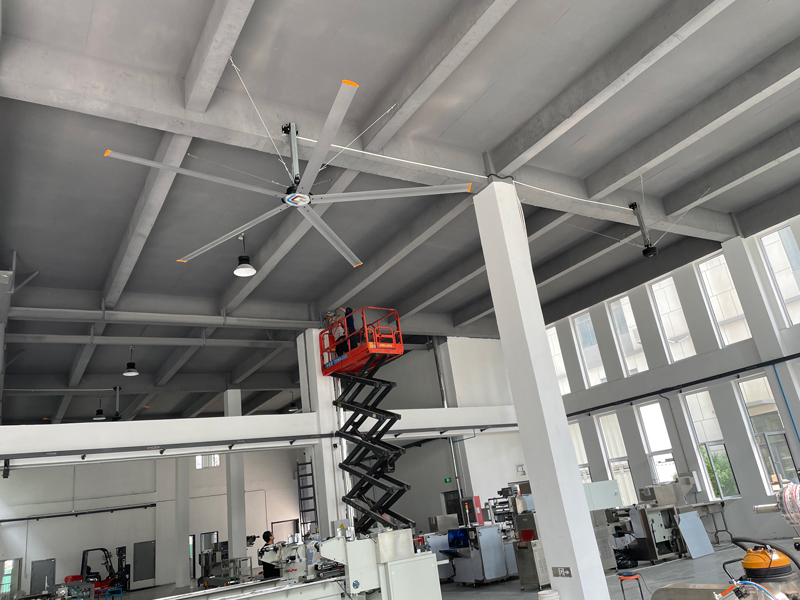
Firstly, let's take a look at the "heart" - the motor. The motor is the core component of a large fan. High quality fans commonly use permanent magnet synchronous motors, which have greater force and less heat generation when rotating at low speeds. They are much more energy-efficient than traditional motors and operate very quietly. More importantly, its insulation level should reach F or H level, which means that in harsh factories with high temperature and dust, the coils inside the motor are less likely to burn out and have a longer lifespan. The motor casing must also be dust-proof and waterproof, at least IP55 level, in order to withstand the erosion of industrial environments.
Secondly, look at the "lifeline" - suspension system. Industrial fans weigh hundreds of kilograms and are suspended at heights of tens or even thirty meters. Once dropped, the consequences would be unimaginable. So, the suspension system is of utmost importance in quality inspection. High standard fans will use aviation grade steel wire rope as the main safety rope, which usually has a breaking force of 5 to 8 times the total weight of the fan, leaving a huge safety margin. All bolts at the connection must be of high strength grade and marked with anti loosening marks after installation, making it easy to check for looseness at a glance during daily inspections. The key is that there must be an independent set of auxiliary safety ropes as rear safety, so that even if there is a problem with the main lifting point, the fan can be stably pulled and never fall.
Thirdly, look at the "wings" - leaves. The design and material of the blades directly affect the airflow and noise. The blades of a good fan are designed with precision aerodynamics to propel a large amount of air at low speeds while maintaining extremely low noise. In terms of material, the mainstream now is to use high-strength engineering plastics or carbon fiber composite materials, which are lighter, more corrosion-resistant, and can also create more efficient wing shapes than traditional metal blades. Each blade must undergo strict weighing and matching before leaving the factory to ensure that the weight of the entire set of blades is consistent. After installation on the wheel hub, the entire fan also needs to undergo dynamic balance correction to ensure smooth rotation, no shaking, and no abnormal noise or additional wear.
Fourth, look at the "brain" - the control system. Modern high-quality large fans are equipped with intelligent variable frequency controllers. It can not only achieve stepless speed regulation, allowing wind speed to switch freely according to seasons and needs (cooling in summer and circulating hot air in winter), but more importantly, it has multiple protection functions, such as automatic shutdown and alarm when current is too high, voltage is unstable, or temperature is too high. Some advanced systems even have built-in vibration monitoring, which will immediately trigger emergency braking once the fan swings abnormally, nip the risk in the bud. Remote control through mobile phones or computers, timed switches, and checking energy consumption have also become standard features of good fans.
Look at the 'backing' - manufacturing and quality assurance. A high-quality brand conducts several hours of full load aging testing on each fan before leaving the factory, and provides detailed performance reports. They have international certifications such as CE and UL, which prove that their products have undergone strict third-party testing. In the installation process, the manufacturer will provide professional installation training and acceptance standards to ensure that "a good horse matches a good saddle". The quality assurance policy is also a touchstone of quality. Products usually provide a warranty of two to three years for the entire machine and more than five years for the motor, and promise fast on-site service. Behind this is full confidence in the lifespan of their own products.
In short, the quality of industrial fans is a comprehensive reflection of safety redundancy, high efficiency and energy saving, and long-term durability. It cannot only look at the price, but also at the invisible details - whether the motor insulation is good enough, whether the safety rope is thick enough, whether the blades are flat or unbalanced, and whether the control system is smart enough. A high-quality fan can operate steadily, quietly, and safely at high altitudes for ten years, which is its true value.


