In large factories, logistics centers, and livestock farms, we often see giant ceiling fans with a diameter of 6 meters or even 7.3 meters or more. But when it comes to procurement, many companies face a choice: between ordinary commercial ceiling fans (cheap) and professional industrial energy-saving ceiling fans (expensive), how should they choose?
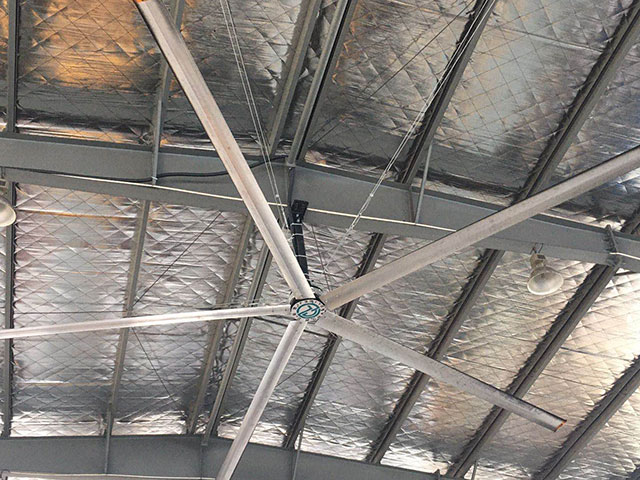
Conclusion first: Industrial energy-saving ceiling fans are far superior to ordinary ceiling fans in long-term operation. The so-called 'usability' is reflected in the following four dimensions of generational differences:
1、 Core essence: Permanent magnet synchronous motor vs asynchronous reduction motor (intergenerational crushing)
This is the fundamental difference between the two, and it is also the key to determining whether it is effective or not.
Ordinary ceiling fans often use three-phase asynchronous motors and worm gear reducers. This combination has a large volume and low transmission efficiency (only about 70%~80%), and the internal gears of the reducer will inevitably wear out during long-term operation, resulting in increased noise and high risk of oil leakage.
Industrial energy-saving ceiling fan: using permanent magnet synchronous external rotor motor (direct drive technology). The motor directly drives the fan blades, without gearbox or transmission loss, with a transmission efficiency of over 95%.
The utility lies in the fact that the industrial energy-saving ceiling fan completely eliminates the pain points of later maintenance caused by gear wear, and the motor has a smaller volume, lighter weight, lower load-bearing requirements for the roof steel structure, and safer installation.
2、 Energy consumption performance: True "energy saving" is the real money saved
Although ordinary ceiling fans can also blow air, there is a huge gap in energy efficiency ratio.
Ordinary ceiling fan: covering the same area (about 1500 square meters), its motor power is generally between 2.2kW and 4.0kW. Due to the need to overcome the frictional resistance of the gearbox, the actual input power is much greater than the output power.
Industrial energy-saving ceiling fan: Thanks to the high power density of permanent magnet synchronous motors, it only requires an input power of 1.5kW or even 1.2kW to cover the same area.
Data comparison:
Assuming 10 hours of daily operation, the industrial electricity price is 1 yuan/kWh:
Ordinary fan: Annual electricity cost ≈ 3.5kW × 10h × 365 days=12775 yuan
Energy saving fan: Annual electricity cost ≈ 1.5kW × 10h × 365 days=5475 yuan
Each unit saves over 7000 yuan in electricity bills annually. Usually, within one year, the saved electricity bills can offset the purchase price difference between the two.
3、 Wind sensation and coverage: a qualitative change from "local blowing" to "three-dimensional replacement"
Due to the torque limitation of the motor, the blade angle of ordinary ceiling fans is usually steep (high angle of attack), resulting in high-speed, rigid columnar wind during operation, with a small coverage area and easy formation of vortices, causing dizziness and significant wind noise.
Industrial energy-saving ceiling fans use aviation grade airfoil streamlined blades (usually made of high-strength aluminum alloy or carbon fiber material), combined with high torque permanent magnet motors, allowing the blades to operate smoothly at extremely low speeds (about 45-55 revolutions per minute).
Forming a "tornado" effect: large diameter fan blades push a huge column of air from top to bottom to impact the ground, and when blocked by the ground, it spreads evenly in all directions. This type of wind is a three-dimensional, wide, and gentle natural wind, covering a diameter of up to 20 meters or more.
Sensory advantage: Ordinary fans can only blow to the area directly below, while energy-saving fans can make the entire workshop feel a uniform breeze, with a more balanced temperature difference, avoiding the embarrassment of "cold below the fan and stuffy in the distance".
4、 Lifespan and reliability: maintenance free vs high maintenance
The factory environment is dusty, high-temperature, and highly vibrating, requiring extremely high stability for the equipment.
Ordinary ceiling fan: The gear of the reducer needs to be regularly lubricated (frequently refilled), and the oil seal is prone to oil leakage and pollution of the products or equipment below after aging. After the wear and tear of the worm gear, the noise becomes increasingly harsh, and during maintenance, the entire machine must be disassembled and returned to the factory, resulting in a long downtime.
Industrial energy-saving ceiling fan: The permanent magnet direct drive motor has no mechanical wear parts except for bearings. The design lifespan is generally between 15 to 20 years, and key bearings are maintenance free (such as SKF or NSK sealed bearings). Daily maintenance only requires checking the fastening bolts once a year, almost achieving the reliability of "forgetting to install".
5、 Value added: Intelligent experience of variable frequency speed regulation
Ordinary ceiling fans: mostly fixed frequency switches with only a few fixed speeds of "fast" and "slow", unable to adapt to subtle changes in climate.
Industrial energy-saving ceiling fan: usually equipped with a variable frequency controller, which can achieve stepless speed regulation (0%~100 continuously variable speed). When strong winds are not needed in spring and autumn, the "breeze mode" can be switched to only replace the air; Switch to 'strong wind mode' during the scorching heat. Some high-end models even support automatic adjustment of wind speed through mobile apps or environmental sensors, truly integrating into the IoT system of modern smart factories.
Summary: What kind of factory is suitable for "industrial energy-saving ceiling fans"?
If your workshop is only a temporary warehouse or for short-term turnover (relocation within 2-3 years), choosing a regular large ceiling fan may be a temporary solution.
But if it is a long-term (more than 5 years), high load (8-10 hours of operation per day in summer) operation, it is strongly recommended to choose industrial energy-saving large ceiling fans. Although the former is several thousand yuan more expensive when purchased for the first time, its lower electricity bill, lower maintenance frequency, more comfortable wind sensation, and longer service life determine that it has a certain crush on ordinary large ceiling fans in terms of "usability" evaluation criteria.
One sentence conclusion: Industrial energy-saving ceiling fans are investments (saving money), while ordinary ceiling fans are consumption (spending money).


