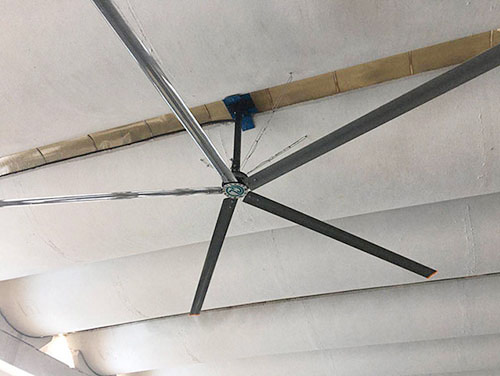
In the impression of many people, the "giant" fans with a diameter of up to 7 meters hanging from the ceiling in the workshop look like heavy industrial machinery, and the operation panel must be covered with buttons and instruments that non professionals dare not touch. But the fact is quite the opposite: one of the core concepts of workshop fans is "minimalist operation". It can even be said that frontline workers spend no more than one minute on hands-on learning.
Let's explore the actual operation scenario:
1、 Mainstream operating method: rotary knob control with "one twist, one press"
At present, the vast majority of industrial energy-saving ceiling fans on the market come standard with an infinite speed control knob control box, which looks similar to the volume knob of a home audio system.
Start: Rotate the knob clockwise from the "0" position. At this point, the fan begins to climb slowly at low speed, starting very gently without any momentary impact.
Speed regulation: If you want more wind, continue rotating the knob. There is no lag between 0 and 100, which belongs to linear continuously variable transmission. The air volume is completely determined by the rotation angle, and the feel is intuitive.
Stop: Simply turn the knob counterclockwise back to the "0" position, and the fan will naturally and smoothly decelerate to a complete stop within a few seconds with its own resistance (some models with electric magnetic brakes may be slightly faster).
Operational complexity: ☆ (almost zero). No professional training is required, as long as you can turn the faucet, you can operate this large fan.
2、 Advanced intelligent operation: mobile phone or remote control panel
For modern workshops (especially unmanned or less manned warehouses), many manufacturers have introduced more convenient control methods:
Handheld wireless remote control:
This is a device similar to a car key or an electric curtain remote control. There are usually only a few buttons on it, such as "start/stop", "wind speed+", "wind speed -", "timer", etc. Workers can remotely control the start and stop of the fan from a forklift or several tens of meters away. No need to walk back and forth to the wall switch, greatly improving convenience.
Mobile APP/Mini Program Control (Industrial Internet of Things):
For fans equipped with IoT modules, administrators only need to download a dedicated app on their mobile phones to remotely control all fans in the entire workshop from the office. At what time to turn on and off, set a specific temperature for automatic transmission, all at your fingertips, and even view the real-time power consumption of each fan.
3、 Comfortable 'foolproof' safety interlock
Simple operation does not mean a lack of protection. Although the operation interface of the workshop fan is simple, its internal logic is designed with strict safety protection to ensure that the operator will not cause danger due to "misoperation":
Anti fall safety self-locking: When the control system detects abnormal vibration or abnormal tension in the steel wire rope, the system will automatically trigger emergency braking and sound and light alarms, without the need for manual judgment.
One click emergency stop: Both the control box and remote control are equipped with a prominent red mushroom head emergency stop button. No matter what speed the fan is at, press this button to immediately power off and lock the fan (only for emergency use, it is not recommended to press this button for regular shutdown).
Anti misoperation startup: Some models have power-off memory function and will not automatically start after being powered on again. The startup command must be manually triggered to prevent the fan from injuring people due to sudden power on.
4、 Why do people feel 'complicated'? ——That's maintenance, not operation
A misconception needs to be clarified: many buyers confuse "installation and maintenance" with "daily operations".
Installation and maintenance: It is indeed necessary for professional certified personnel to use lifting trucks for bolt tightening and electrical wiring, which falls within the scope of engineering.
Daily operation: completely designed for frontline production workers. The design logic follows the principle of "hidden functions, exposed operations" - complex frequency conversion algorithms, overload protection, and phase sequence detection are all automatically completed on the circuit board inside the control box, without requiring the operator to have any electrical knowledge.
5、 Compared to home ceiling fans: What are the operational differences?
Home ceiling fan: usually a rope switch or wall speed controller, with fixed gear (such as 1-2-3-4 gears), unable to be finely adjusted.
Workshop fan: The operating principle is exactly the same, but it is smarter than household fans. It doesn't have confusing combination keys or complex menu directories. If you have to find a difference, the difference is that the knob of the workshop fan feels heavier and more solid, because it needs to match the durability of industrial grade.
Conclusion
So, back to the question we started with: Is it easy to operate the workshop fan?
The answer is very definite: extremely simple.
Its operating logic is so simple that it doesn't even require reading the manual. For frontline workers, the difficulty level of "turning the knob to adjust the air volume" and "turning on/off the lights" is completely the same. The workshop is equipped with large fans not only for cooling, but also to reduce energy consumption without adding any additional training costs or operational risks to production management. Truly achieving 'ready to use and easily adjustable upon installation'.


