For large exhaust fans (such as negative pressure fans or large-diameter axial fans used in industrial plants, livestock farms, and large workshops), the "how to" approach to their use mainly falls into three core dimensions: how to select the right model (buying the right one), how to install it correctly (positioning it properly), and how to maintain it effectively (taking proper care of it).
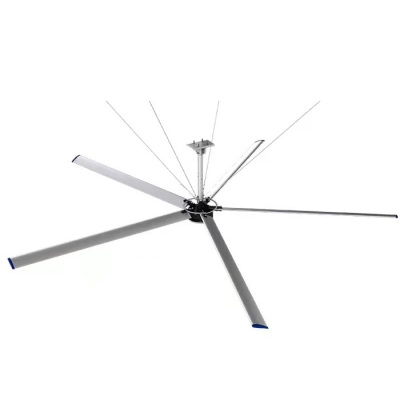
Here is a full-process operation guide:
1. How to choose the model (core: air volume and static pressure)
Large exhaust fans are not necessarily better; instead, it's about "treating the symptoms".
Check the spatial volume (calculate the air volume):
Formula: Required air volume (m³/h) = Factory building volume (length × width × height) × Air change rate (times/h).
Reference frequency: For workshops, it is generally 30-40 times/hour; for livestock farming (livestock and poultry houses), it is generally 60-80 times/hour; for high-temperature forging workshops, it is required to be 80-100 times/hour.
Check the length of the pipeline (calculate static pressure):
If it is to be directly discharged outside the wall, choose an axial flow type (with high air volume but low pressure).
If the pipeline is long, has bends, or requires a bag filter, a centrifugal type must be chosen (with high air pressure to overcome resistance). Otherwise, the air will not travel far after being purchased and will only spin around at the machine's mouth.
Check the energy efficiency of the motor:
For large fans (diameter > 1 meter), it is recommended to prioritize IE3/IE4 Class A energy efficiency or permanent magnet synchronous motors. Although they are more expensive, the annual electricity savings compared to ordinary motors may exceed the price difference of the machine itself.
II. How to install (key points: anti-resonance and sealing)
The vibration of large exhaust fans is extremely strong, and improper installation can lead to wall cracks or fan blade breakage.
Installation location:
Negative pressure ventilation: installed on the leeward side of the factory building (the side opposite to the prevailing wind direction in summer), it utilizes negative pressure to draw fresh air in from the opposite windows, creating a "cross-ventilation" effect.
Height: The center of the fan blades should be no less than 2.5 meters above the ground (safety height), and it is generally installed at 1/3 of the distance below the roof (where there is more accumulation of hot air, and the heat dissipation effect is suitable).
Shock absorption measures (crucial for survival):
It is strictly prohibited to use expansion bolts for direct and rigid attachment to brick walls! It is necessary to install rubber shock pads or spring shock absorbers.
If it is a steel structure factory building, it is necessary to weld channel steel reinforcement at the purlin locations to prevent noise generated by iron sheet resonance (the noise is usually louder than wind noise).
Protective net:
A fine protective net must be installed on the indoor side (air inlet) to prevent workers' hair or clothing from being entangled; an electric shutter should be installed on the outdoor side (air outlet) (which automatically closes when the machine is stopped to prevent rainwater from flowing back).
III. How to operate correctly (startup and operation)
Large fans cannot be operated as freely as small fans, with the ability to be turned on and off at will.
Starting with load is strictly prohibited:
Before starting, ensure that the shutters are open (either manually or electrically). If it is a directly operated large fan, the air door must be closed before pressing the start button, otherwise the motor start current will be too high (up to 7 times the rated current), which can easily burn out the contactor.
Soft start of frequency converter (recommended):
If the budget allows, it is essential to install a frequency converter. This not only allows the large fan to gradually increase its speed (avoiding the impact on the power grid when it is just started), but also enables automatic speed adjustment based on the temperature in the workshop (for example, running at low frequency for ventilation in the morning and at high frequency for cooling in the afternoon).
Reverse ash removal:
Some large fans are equipped with a reverse rotation function. After shutdown each week, jog the motor in reverse for 3-5 seconds (note that it is jogging, not continuous running), using centrifugal force to shake off the cotton fibers or dust attached to the fan blades and maintain dynamic balance.
IV. How to maintain and care for it (rules for extending its lifespan)
The maintenance cost of large exhaust fans is high, and the core of maintenance lies in "balancing" and "lubricating".
Daily inspection (listening to sounds):
During operation, if you hear a "clunk" or regular friction sound, stop the machine immediately. This usually indicates bearing wear or blade deformation rubbing against the edge, and even a minute of additional rotation may cause the motor to seize and become useless.
Monthly tightening (to prevent loosening):
Large fan vibration can cause the fixing bolts to back out automatically. It is necessary to use a torque wrench to tighten the fan blade lock nuts and foundation bolts every month. If the fan blade flies out, it will result in a safety accident.
Quarterly grease injection (lubrication):
Use high-temperature lithium-based grease (butter) and inject it through the bearing oil filling hole with a grease gun until the old oil is squeezed out from the oil seal. Be sure not to add too much, as excessive internal pressure may cause damage to the seal.
Leveling (dynamic balancing) every six months:
Even if only 5 grams of mud adheres to the blades, it will cause the main shaft to bend after half a year of operation. After cleaning the blades, the vibration value must be measured using a dynamic balancer (with an amplitude not exceeding 4.5mm/s to be considered satisfactory). If a blade is damaged, it must be replaced in pairs (replace two symmetrical blades), and cannot be replaced individually.
V. Special Reminder (Safety Taboo)
Power off during thunderstorms: Large fans often use external rotor motors, and lightning may be conducted through outdoor metal casings, potentially damaging the controller and even causing injury.
Belt tightness: If it is a belt drive, press the middle section of the belt, and the deflection should be 1.5%-2% of the center-to-center distance of the pulley. If it is too tight, the bearing will burn; if it is too loose, the speed will drop, and it may slip and catch fire.
One sentence to summarize the tips: Calculate the air volume before buying a fan, add shock absorption and reinforcement to prevent vibration; use soft start and variable frequency to save energy, and listen to the sound frequently to ensure safety.


