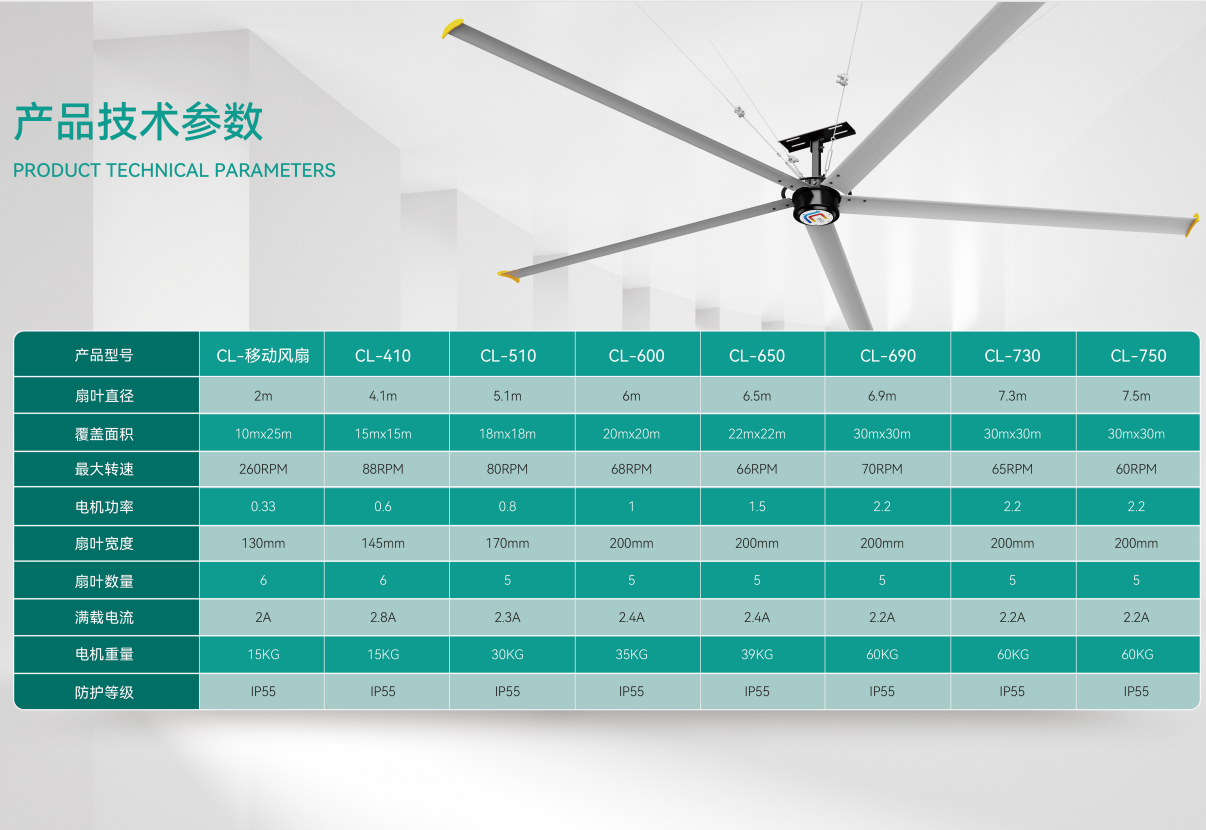
Factory workshop large fans usually refer to large industrial ceiling fans that have become very popular in the industrial field in recent years (with a diameter generally between 2.5 meters and 7.3 meters, also known as HVLS fans, or High Volume, Low Speed high air volume low-speed fans).
The usage effect of this type of fan can be summarized in one word: high air volume, low speed, and all-round coverage. It solves the pain points of traditional high-speed small fans that blow hard, have a small coverage area, and can only locally cool down.
To give you a more intuitive understanding of its effects, we can analyze it from three dimensions: physical sensation, environmental improvement, and economy:
1. Physical sensation: gentle "natural wind" and perceived cooling
Full sensory experience (high air volume):
The wind blown out by traditional industrial fans (cow angle fans) is like a "fist", hitting the body hard, but it disappears from a few meters away. And large industrial ceiling fans use huge fan blades (similar to the principle of airplane propellers) to drive a huge volume of air flow, producing all-round and diffuse wind. Standing under the fan, you will feel your whole body enveloped by a gentle airflow, rather than just being blown to one side.
Sensory cooling (air cooling effect):
It does not directly lower the air temperature, but passes through the human skin at high wind speeds, accelerating sweat evaporation and taking away heat. Usually, it can make the human body feel a temperature difference of 3-5 ℃. In a stuffy workshop, even if the temperature hasn't changed, places with wind will feel much more comfortable.
2. Environmental improvement: Eliminating stratification and dehumidification
Eliminate air stratification:
The factory building is usually very high, with hot air gathering on the roof and cold air sinking below (in summer, the top may reach 40 degrees and the ground may reach 35 degrees). The powerful downward airflow of a large ceiling fan can forcefully blow the hot air from the top towards the ground and mix it, making the temperature of the entire workshop more uniform. When used in conjunction with heating equipment in winter, the accumulated heat at the top can also be compressed to save heating costs.
Ventilation and dehumidification:
Continuous air circulation can accelerate the evaporation of ground moisture, reduce surface water, and lower the risk of slipping or moldy items caused by humidity.
3. Core pain point solution: zero blind spot coverage
This is an effect that many workshop managers value.
Large diameter coverage: A fan with a diameter of 7.3 meters can cover an area of approximately 1800 square meters (about half a football field). Only a few units need to be installed on the pillars to cover the entire workshop, avoiding the chaotic situation of traditional fans with power strips scattered all over the floor, one in the east and one in the west, and obstructing forklift traffic.
4. Economy and Energy Consumption: Saving money is the key principle
Extremely low energy consumption: Although it is huge in size, due to its low rotational speed (usually only 30-60 revolutions per minute), the motor power is very small (usually only 1.1kW-1.5kW). Running for a day, the electricity bill is usually only a few dollars. In contrast, to achieve the same coverage effect, if dozens of floor standing industrial fans are used, the total power will be much higher.
Maintenance free: Due to its relatively simple structure (no oil, no complex transmission mechanism), it has a long service life and is basically maintenance free.
5. Limitations to be aware of
Although the effect is good, there are also some things to pay attention to in specific scenarios:
Not suitable for workshops with extremely high dust: If there is very fine dust in the workshop (such as flour, sawdust powder, spraying workshop), strong airflow may cause the dust to diffuse and increase safety hazards.
Ineffective for high temperature and humidity: If the temperature in the workshop has reached 38 degrees and the humidity is extremely high (like in a sauna), the wind blown out by the fan is also hot air, which can only be solved by ventilation and air exchange. Simply relying on the fan for cooling has limited effectiveness.
Installation height requirement: The bottom of the fan is usually required to be at least 4 meters above the ground. If the workshop is too low, the airflow may be uneven and there may be safety hazards.
Summary suggestion:
If the workshop space you are in is tall, stuffy, with high personnel flow, and the ventilation conditions are average, installing such large fans can usually bring significant comfort improvements and energy savings. When making a purchase, it is recommended to pay attention to the brand (ensuring the connection strength and safety protection of the fan blades). If it is extremely hot weather in the south, it can be considered to use it together with a negative pressure fan.


