In industrial scenarios, the core role of industrial fans (including large industrial ceiling fans, job-related industrial fans, explosion-proof industrial fans, etc.) revolves around four dimensions: "environmental regulation, efficiency improvement, cost optimization, and safety assurance". Specifically, it can be divided into the following eight core functions, which combine practicality and marketing value, and are suitable for customer pain points in B2B scenarios:
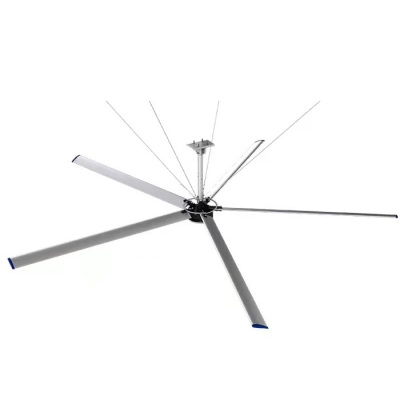
1. Large area ventilation and air exchange to improve air quality
Covering large spaces such as workshops, warehouses, and factories (a single large ceiling fan can cover 1000-2000 square meters), accelerating air circulation, quickly discharging dust, oil fumes, harmful gases (such as welding waste gas, chemical volatiles), and humid water vapor, reducing indoor stuffiness and stuffiness.
Applicable scenarios: mechanical processing workshops, chemical plants, warehousing and logistics centers, breeding greenhouses, especially for enclosed/semi enclosed spaces, to reduce occupational disease risks and comply with safety production standards.
2. Cooling and relieving heat, improving personnel comfort and production efficiency
Utilizing air flow to accelerate the evaporation of human sweat, achieving "natural cooling" (perceived cooling of 3-8 ℃), and avoiding employee fatigue and lack of concentration caused by high temperature environments.
Compared to traditional air conditioning, it has a wider coverage and lower energy consumption, making it suitable for open/semi open spaces such as workshop assembly lines and loading and unloading platforms. When used in conjunction with air conditioning, it can reduce air conditioning load and achieve "zone cooling".
3. Energy conservation and consumption reduction, reducing operating costs
Large industrial fans have a power of only 1.5-3kW, a daily operating cost of less than 10 yuan, and energy consumption of only 1/10-1/20 of air conditioning, making them suitable for long-term and large-scale use.
Replace multiple small fans: reduce equipment procurement and maintenance costs, while reducing circuit load and avoiding tripping problems caused by multiple devices running simultaneously.
4. Moisture proofing and dehumidification to protect materials and equipment
Accelerate air circulation, reduce indoor humidity (especially during rainy seasons and humid areas in the south), prevent raw materials and finished products (such as paper and metal parts) from getting damp, moldy, and corroded, and extend the service life of equipment.
Applicable scenarios: Warehouses, electronic component workshops, food processing workshops (production lines for moisture-proof products).
5. Auxiliary ventilation and dust removal, combined with environmental protection equipment to enhance effectiveness
In scenes with high levels of dust, such as woodworking workshops and building materials processing workshops, using dust removal equipment can accelerate dust diffusion and collection, reduce the residence time of dust in the air, lower the risk of dust explosion, and comply with environmental emission standards.
6. Accurately supply air to the position and adapt to special job requirements
Post type industrial fans can accurately supply air to specific work areas (such as welding stations and assembly lines), avoiding the impact of large-scale blowing on precision operations while meeting the cooling needs of workers.
Explosion proof industrial fan (suitable for flammable and explosive scenarios such as chemical, oil and gas): adopting explosion-proof design to prevent electric sparks generated during operation and ensure the safety of operations in special environments.
7. Specialized for agricultural/breeding scenarios: regulating environmental balance
Breeding greenhouses (chicken houses, pig houses): accelerate air circulation, reduce ammonia concentration, regulate greenhouse temperature, reduce disease occurrence, and improve breeding survival rate;
Greenhouse: Promote crop ventilation, avoid pests and diseases caused by high temperature and humidity, and improve crop yield and quality.
8. Emergency ventilation to ensure personnel safety
In case of sudden power outage or ventilation equipment failure, industrial fans can be used as emergency ventilation equipment to quickly discharge harmful gases indoors, saving time for personnel evacuation and equipment repair (especially in enclosed factories and underground workshops).


