Factory fan (also known as industrial fan or large industrial ceiling fan) is an efficient equipment designed for ventilation and cooling in high-rise spaces. Its specifications and parameters need to be adapted to the height, area, ambient temperature, and operational requirements of the factory. The core parameters cover four categories: size, performance, electrical, and safety, as follows:
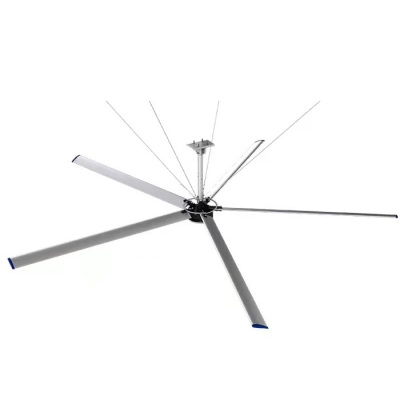
1、 Core Dimensional Parameters: Suitable for Factory Space Layout
The size parameters directly determine the coverage range and installation adaptability of the fan, and are the primary basis for selection.
Fan blade diameter: The core size of industrial large fans, with mainstream specifications ranging from 1.5 meters to 7.3 meters, and different diameters corresponding to different coverage areas:
Small size (1.5-3 meters): suitable for small workshops and local work areas, with a single unit covering an area of 50-100 square meters;
Medium size (3-5 meters): Suitable for medium-sized factories and warehouses, with a single unit covering an area of 100-300 square meters;
Large size (5-7.3 meters): For large steel structure factories and logistics warehouses, a single unit can cover an area of 300-1000 square meters.
Installation height: The safe height from the bottom of the fan to the ground is usually required to be ≥ 3.5 meters, and the suitable installation height is 4-10 meters. Insufficient height can affect the effectiveness of airflow circulation and pose safety hazards; If it is too high, it will weaken the ground wind speed.
Number and thickness of fan blades: The common number of fan blades is 3-6, and the thickness of fan blades varies depending on the material. Aluminum alloy fan blades are mostly 2-3mm thick, while engineering plastic fan blades are 3-5mm thick. The number and thickness of fan blades directly affect the air volume and operational stability.
Whole machine weight: including the total weight of fan blades, motors, and installation brackets, usually between 50-200kg. When selecting, it is necessary to consider the load-bearing capacity of the factory's steel structure or concrete beams.
2、 Key performance parameters: determine the ventilation and cooling effect
Performance parameters directly reflect the effectiveness of fan usage and are the core indicators for evaluating equipment efficiency.
Airflow and wind speed:
Airflow: The volume of air transported per unit time, measured in m ³/h. The mainstream product airflow ranges from 10000-100000m ³/h, and a 7.3-meter diameter fan can achieve an airflow of 80000-100000m ³/h, enabling large-scale air circulation.
Wind speed: The effective wind speed on the ground is usually controlled at 1-3m/s. This wind speed range can provide a comfortable cooling sensation without affecting production operations (such as the placement of paper and light materials).
Speed: The number of revolutions per minute of the fan blades, measured in rpm. Industrial large fans are designed for low speeds, with a mainstream speed of 10-50rpm. By rotating the large-diameter fan blades at low speeds, a "gentle breeze and wide area" ventilation effect is achieved, avoiding noise and energy consumption problems caused by high speeds.
Energy efficiency ratio: a key indicator for measuring the energy efficiency of fans, measured in m ³/(h · W), which refers to the amount of air generated for every watt of electricity consumed. The energy efficiency ratio of high-quality products can reach 200-300m ³/(h · W), far exceeding traditional small fans and significantly reducing long-term operating costs.
Coverage area: The ground area effectively covered by a single fan is affected by the diameter of the fan blades, installation height, and speed. When selecting, the required number of fans should be calculated based on the factory area to ensure no ventilation blind spots.
3、 Electrical and motor parameters: ensuring stable operation
The electrical parameters are related to the adaptability, energy consumption, and operational stability of the equipment, and need to be matched with the power supply conditions of the factory building.
Motor type:
Permanent magnet synchronous motor: a mainstream high-end configuration with the characteristics of high efficiency, energy saving, low noise, and long service life. Its energy efficiency level can reach IE4 or above, saving 20% -30% energy compared to traditional asynchronous motors;
Asynchronous motor: economical configuration, low cost, with energy efficiency levels mostly ranging from IE2 to IE3, suitable for budget limited scenarios.
Rated power: The power of a motor during normal operation, measured in kW. The power increases with the diameter of the fan blades. A 1.5-meter fan has a power of about 0.5kW, while a 7.3-meter fan has a power range of 1.5-2.2kW. The higher the power, the stronger the air volume and coverage capacity.
Rated voltage and frequency: Suitable for the power supply standards of the factory building. The mainstream in China is 380V/50Hz three-phase power, and some small fans support 220V single-phase power. When selecting, it is necessary to confirm the power supply conditions of the factory building.
Control method:
Basic model: manual switch, gear adjustment;
Intelligent version: supports variable frequency speed regulation, remote control, mobile APP control, timed switch, and some can be connected to the factory's intelligent control system to achieve linkage control of multiple fans.
4、 Safety and Material Parameters: Ensuring Job Safety
Safety parameters are mandatory requirements for use in industrial environments, directly related to personnel and equipment safety.
Safety protection
Fan leaf protective net: to prevent foreign objects from getting involved or personnel from accidentally touching, the aperture of the protective net is usually ≤ 50mm and must comply with national safety standards;
Anti fall device: The installation bracket is equipped with dual anti fall locks to prevent the fan from falling off;
Overload protection: The motor is equipped with built-in overload and overheating protection devices to prevent motor burnout caused by unstable voltage or high load.
Material performance:
Fan blade material: The mainstream is high-strength aviation aluminum alloy, which has the characteristics of light weight, high strength, and corrosion resistance, suitable for humid and dusty factory environments; Some products use engineering plastics, which have lower costs but slightly weaker strength;
Bracket material: Carbon steel galvanized or stainless steel material, with good load-bearing capacity and corrosion resistance, suitable for different factory environments.
Noise level: The noise level during operation, measured in dB (A). The noise level of high-quality industrial fans is controlled between 50-60dB (A), which is equivalent to the volume of normal conversation and will not affect production operations and personnel communication in the factory.


