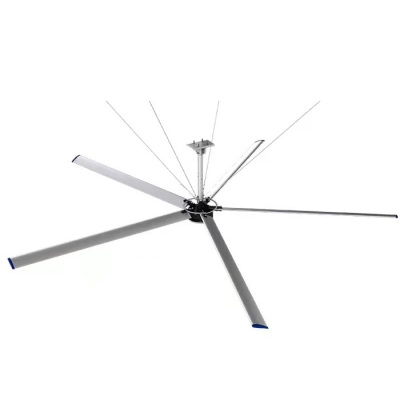
Large fans used in factories (usually referring to industrial ceiling fans, industrial fans, etc., which are different from ordinary household fans and have the characteristics of large air volume, wide coverage, and low energy consumption) can provide multidimensional solutions for the special environment of factories (such as high space, dense personnel, equipment heating, poor ventilation, etc.). The "convenience" they bring is mainly reflected in four core aspects: environmental improvement, cost optimization, safety guarantee, and production assistance, as follows:
1、 Core value: Improve the factory environment and enhance personnel comfort
Factory buildings (especially steel structure factories and workshops) commonly suffer from problems such as "tall and spacious buildings, poor air circulation, and local stuffiness/humidity". Industrial fans can alleviate these pain points from the root:
Global ventilation and air exchange, bidding farewell to stuffiness. The diameter of the fan blades of industrial fans is usually between 1.5 meters and 7.3 meters. During operation, it can push a large amount of air to form a "columnar airflow" from top to bottom, which then spreads along the ground to various corners of the factory building, achieving "global air circulation". Compared to the "local blowing" of ordinary small fans, it can quickly replace the hot air at the top of the factory with the cold air on the ground, effectively reducing the ambient temperature by 3-5 ℃ and avoiding personnel from becoming irritable and fatigued due to long-term exposure to hot and humid environments. It is especially suitable for densely populated areas such as welding workshops and assembly workshops.
Adjust humidity to suppress mold and rust. Some factories (such as textile factories, food processing workshops, and storage workshops) are prone to accumulating moisture due to poor ventilation, which can cause the ground to regain moisture, equipment/materials to rust, and products to mold. Industrial fans can accelerate water evaporation through continuous air flow, control relative humidity within a more reasonable range (usually reducing by 10% -20%), reduce material loss and equipment failure caused by humidity, and indirectly reduce maintenance costs.
Reduce odors and dust, optimize air quality. If welding fumes, engine oil odors, and dust (such as in polishing workshops and flour processing workshops) accumulate for a long time, it not only affects personnel health but may also pose safety hazards (such as dust explosion risks). The strong airflow of the large fan can dilute and discharge local pollutants out of the factory building (requiring ventilation through doors and windows), reduce suspended particles and irritating odors in the air, and lower the incidence of respiratory diseases among employees.
2、 Cost advantage: replacing traditional equipment, reducing energy consumption and investment
If the ventilation and cooling of a factory rely on equipment such as air conditioning and multiple small fans, it often faces the problems of "high energy consumption and difficult maintenance". The economic advantages of industrial large fans are significant:
Low energy consumption operation leads to a sharp drop in electricity costs. An industrial fan with a diameter of 7.3 meters usually has a power of only 1.5-2.2 kW, and the electricity cost for one hour of operation is less than 1 yuan (calculated at a civilian electricity price of 0.5 yuan/kW · h), but it can cover an area of 1000-1500 square meters. If we replace small fans with the same coverage area (calculated based on 1 fan per 10 square meters and a power of 50W per fan, 100 fans are needed, with a total power of 5kW), running for 8 hours a day can save about 14 yuan in electricity bills, and save over 5000 yuan in electricity bills annually; If air conditioning is replaced, the energy consumption gap will be even greater (the air conditioning power of a 1000 square meter factory is about 50kW, and the electricity cost is more than 20 times that of a large fan).
Easy installation and maintenance, low long-term investment
Installation: Industrial fans are mostly suspended and do not require complex piping or external layout. They only need to be fixed on the steel structure main beam of the factory building, and can be installed in 1-2 days with minimal interference to production;
Maintenance: Core components such as fan blades and motors are designed to have a long lifespan (usually 5-10 years), and only require regular cleaning of fan blade dust and checking of fastener tightness, without the need for frequent maintenance by professional personnel. Compared to maintenance work such as "filter replacement and Freon replenishment" for air conditioners, it is more worry free.
3、 Security guarantee: adapted to industrial scenarios, reducing environmental risks
In the factory environment, equipment heating, dust accumulation, and personnel operation safety are key concerns. Industrial large fans can indirectly improve operational safety:
Auxiliary equipment cooling extends equipment lifespan. Machine tools, injection molding machines, generators, and other equipment in the workshop will continue to generate heat during operation. If the cooling is not timely, it can easily lead to equipment overload, shutdown, decreased accuracy, or even burnout. The airflow generated by industrial fans can directly blow onto the surface of equipment, accelerating heat dissipation, helping equipment maintain normal operating temperature range, reducing equipment failures caused by overheating, and minimizing production losses caused by maintenance downtime.
Reduce the risk of dust explosion (specific scenarios) in workshops that are prone to dust production such as flour, feed, and metal polishing. When the dust is suspended in the air and reaches a certain concentration, it can easily cause an explosion when exposed to a fire source. The "global air circulation" of industrial fans can prevent dust accumulation in local areas, control dust concentration below a safe threshold (with the use of dust removal equipment for better results), and reduce the risk of safety accidents.
Ergonomic cooling reduces operational errors. In high-temperature environments, personnel are prone to problems such as lack of concentration and slow response, increasing the probability of production operation errors (especially in precision assembly, mechanical operation, and other positions). Industrial fans use "natural air cooling" instead of air conditioning's "cold air direct blowing" to make the human body more comfortable, reduce fatigue caused by stuffiness, and indirectly improve work accuracy and safety.
4、 Production assistance: indirectly improving efficiency and ensuring product quality
In addition to direct "environmental improvement", industrial fans can also assist production through indirect effects:
Reducing staff leave and maintaining a stable production pace in a comfortable working environment can reduce the frequency of employees taking leave due to issues such as heatstroke and respiratory discomfort, ensuring workshop attendance and avoiding production delays caused by personnel shortages.
To ensure the quality of sensitive products (specific industries), some products (such as electronic components, pharmaceutical intermediates, textile fabrics) require high temperature, humidity, and cleanliness in the storage/production environment. When industrial fans are used in conjunction with air conditioners and dehumidifiers, they can make the temperature and humidity more uniform (avoiding "local supercooling and local overheating" of air conditioners), reducing the problem of product qualification rate decline caused by uneven environment.
Summary: The "convenience" essence of industrial fans is "targeted solutions to address pain points in factories"
Compared to ordinary fans, its core value lies in achieving "global and uniform" ventilation and cooling with extremely low energy consumption; Compared to air conditioning, its advantages are simple installation and maintenance, no "air conditioning disease" troubles, and adaptability to tall and spacious factory scenes. For the vast majority of industrial plants, they are not "optional appliances", but practical equipment that can directly relate to "personnel comfort, production efficiency, operating costs, and job safety".


