 English

 English
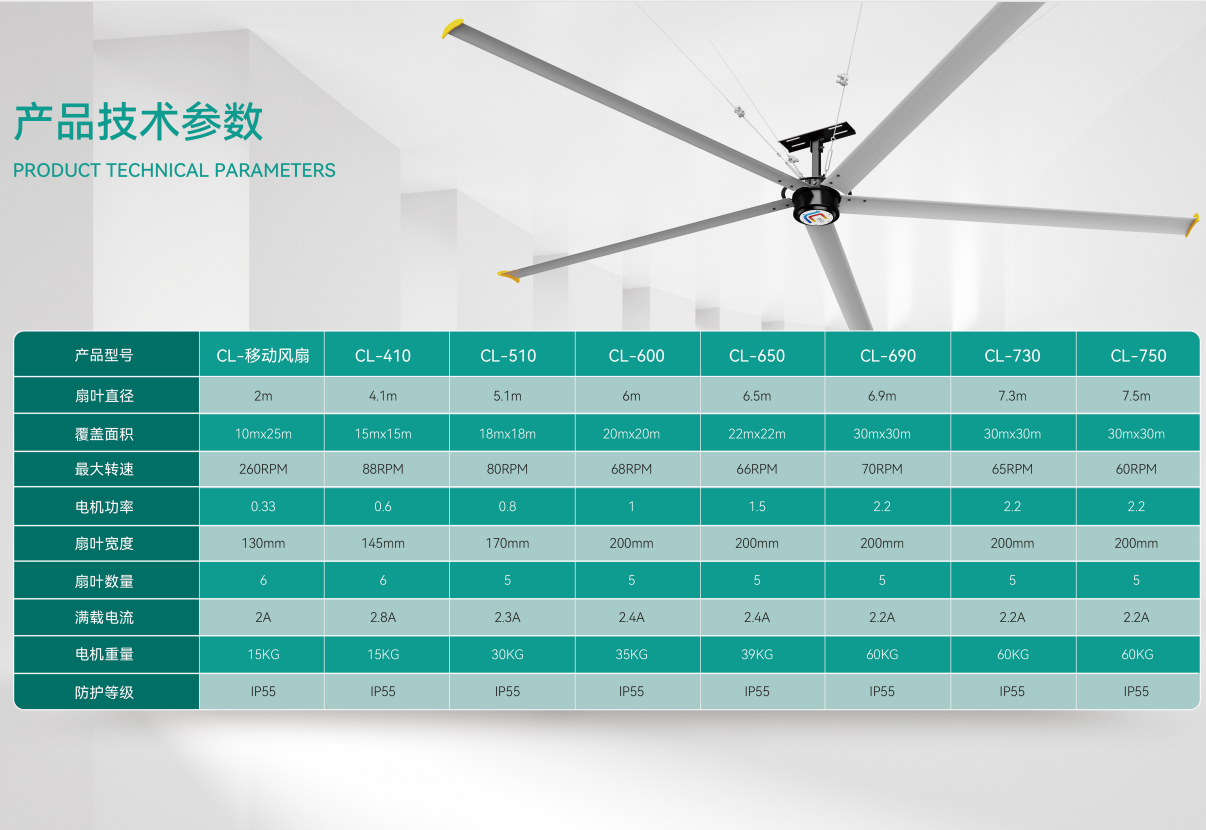
Industrial large fans, as large-scale ventilation and cooling equipment, have the characteristics of strong air volume, wide coverage, and low energy consumption. They are widely used in factories, warehouses, logistics centers, and other places. Its daily use must strictly follow safety regulations and maintenance requirements to ensure stable operation of the equipment, extend its service life, and avoid safety accidents. The following are the core precautions for daily use of industrial fans, classified and explained according to four dimensions: "pre use inspection", "operation standardization", "maintenance after shutdown", and "special scenario taboos":
1、 Before use: Safety and functional checks must be conducted
Before starting the industrial fan, a comprehensive inspection must be completed to eliminate potential hazards, which is the foundation for safe operation.
Electrical system inspection
Check whether the power cord, plug, and terminal block are damaged, aged, or loose (such as cracked cable sheaths or loose terminal screws). If any problems are found, they should be replaced or tightened immediately to avoid short circuits and leakage.
Confirm that the circuit breakers and overload protection devices in the distribution box are in normal condition, and that the grounding circuit is firmly connected (the grounding resistance should comply with national standards, usually ≤ 4 Ω) to prevent electric shock accidents.
After the first start-up or long-term shutdown, it is recommended to use a multimeter to check the insulation resistance of the motor (phase to phase and relative to ground insulation resistance should be ≥ 0.5M Ω) to avoid motor failure caused by moisture.
Mechanical structure inspection
Check the fan blades: Check whether the blades are deformed, cracked, or corroded (such as corroded metal blades or damaged composite blades), and whether the blade fixing screws are tightened (use a torque wrench to check according to the manufacturer's specified torque to prevent the blades from falling off during high-speed rotation).
Check the hub and gearbox: observe whether the hub connection is loose, and whether the gearbox oil level is between the "low high" scale (low oil level will cause gear wear to worsen, high oil level will increase energy consumption). If the oil is cloudy and has impurities, it needs to be replaced in a timely manner (usually every 6-12 months, special gear oil needs to be replaced).
Check the protective net and bracket: The protective net should be intact without gaps, firmly fixed (to prevent personnel or foreign objects from contacting the blades), and the welds and bolts of the installation bracket (such as the suspended ceiling steel frame) should be free of cracks or looseness, ensuring stable load-bearing capacity (the weight of a single industrial fan can reach 50-150kg, and the bracket should meet a load-bearing coefficient of ≥ 1.5 times).
Environmental and spatial inspection
Confirm that there are no obstacles (such as pipes, beams, or hanging objects) within the coverage area of the fan, and the safe distance between the blades and obstacles should be ≥ 0.5 meters to avoid collision damage to the blades or abnormal noise during operation.
Check if there are any personnel staying or stacking flammable or fragile items below (the air volume of industrial large fans can reach 100000-200000 m ³/h, strong winds may blow down light objects or interfere with operations), and remind personnel in the area to stay away before starting.
2、 During operation: Strictly follow the operating procedures
Real time monitoring of the device's status is required during operation to avoid malfunctions or dangers caused by unauthorized operations.
Startup and speed regulation specifications
When starting, it is necessary to "start at low speed and gradually increase speed": it is strictly prohibited to directly switch to high speed. Starting from low gear (such as gear 1), wait for the motor to run stably for 1-2 minutes, and then adjust to the target speed according to the demand (usually the speed range of industrial large fans is 10-50r/min) to prevent excessive starting current of the motor from burning out the winding.
If there is any abnormal noise or shaking during the speed regulation process, the machine should be stopped immediately for inspection, and the speed regulation should not be forcibly continued (possibly due to unbalanced blade dynamic balance or gearbox failure).
Running status monitoring
Real time observation of whether the fan runs smoothly: there is no obvious "shaking or eccentricity" (the radial runout of the blades should be ≤ 5mm during normal operation), and there is no "metal friction sound or gear abnormal noise" (if there is abnormal noise, it may be due to wear of the gearbox gears or lack of oil in the bearings).
Regularly touch the motor casing: feel if the temperature is normal (the temperature of the motor casing should be ≤ 70 ℃ during operation, and it should not be hot to touch). If the temperature is too high (such as exceeding 80 ℃), stop the machine to check if the cooling fan is faulty and if the motor is overloaded.
Do not touch the blades or remove the protective net during operation: even at low speeds, blade inertia may still cause serious personal injury, and all maintenance must be carried out after shutting down the machine and cutting off the power.
Load and scenario limitations
Do not operate for a long time in a "humid and dusty" environment: humid environments can easily cause motor to become damp and leak electricity, and excessive dust can block the motor's heat dissipation holes and accelerate the wear of the gearbox (such as flour mills and cement plants that require additional dust covers and dehumidification devices).
Overloading operation is strictly prohibited: Some industrial fans have "lifting restrictions" (such as not allowing heavy objects to be hung below), and must strictly follow the manufacturer's regulations. It is not allowed to increase the load without authorization.
3、 After shutdown: regular maintenance and upkeep
Maintenance after shutdown (especially after long-term shutdown or daily operation) is the key to extending equipment life.
Cleaning and maintenance
Cleaning blades: Use a soft cloth or high-pressure air gun (low-pressure mode) to clean the dust and oil stains on the surface of the blades every week (dust accumulation can damage the dynamic balance of the blades and cause shaking during operation), avoid using corrosive cleaning agents (such as strong acids and alkalis), and prevent blade material aging.
Clean the motor and cooling system: Clean the dust on the motor cooling holes and cooling fans every month (can be gently swept away with a brush) to ensure good heat dissipation of the motor and avoid motor burnout caused by poor heat dissipation.
Clean the gearbox: Check if the gearbox vent is blocked every 3 months (blockage of the vent can cause high pressure inside the gearbox and oil leakage). If there are impurities, use compressed air to blow them through.
Lubrication and maintenance
Lubrication of motor bearings: Special lubricating grease (such as lithium based grease) should be added every 6 months, with an amount of 1/2-2/3 of the internal space of the bearing (too much will cause the bearing to heat up, too little will aggravate wear). It is necessary to choose lubricating grease that matches the motor bearing model (refer to the manufacturer's manual).
Gearbox lubrication: Replace the dedicated gear oil (model must meet the manufacturer's requirements, such as L-CKC220 medium load industrial gear oil) every 6-12 months. Before replacement, drain the old oil and add new oil to the specified level. Do not mix different types of gear oil.
Component inspection and replacement
Regular inspection of vulnerable parts: Check the fastening of blade fixing screws and protective net screws every 3 months (re tighten loose screws); Check the wear of motor bearings and gearbox bearings every 12 months (if there is "jamming or abnormal noise" when the bearings rotate, they need to be replaced in a timely manner).
Long term shutdown (such as exceeding one month) treatment: Before shutdown, clean the dust on the surface of the equipment, disconnect the power supply and turn off the main switch of the distribution box. Apply anti rust oil to the surface of metal parts such as blades and gearbox shafts to prevent rusting. Repeat the "pre use inspection" process before restarting.
4、 Special Scenario: Taboos and Emergency Response
Taboo behavior
Unauthorized modification of equipment is prohibited, such as changing motor parameters, cutting blades, increasing the upper limit of speed, etc. Modification can disrupt the original design balance of the equipment and may lead to serious accidents such as blade breakage and motor burnout.
Non professional personnel are prohibited from conducting maintenance: electrical faults (such as motor winding maintenance, circuit modification) and mechanical faults (such as blade dynamic balance calibration, gearbox disassembly) must be operated by authorized professionals from the manufacturer and cannot be disassembled by themselves.
Emergency response process
If there is "leakage, smoking, or severe shaking" during operation, immediately press the emergency stop button or disconnect the main switch of the distribution box, cut off the power supply, and prohibit restarting.
If serious faults such as blade breakage and bracket loosening occur, surrounding personnel should be evacuated immediately, warning signs should be set up, and the manufacturer's after-sales personnel should be contacted for on-site handling. The equipment should not be moved or repaired by oneself.
summary
The core of daily use of industrial fans is "safety first, prevention first" - through comprehensive inspection and elimination of hidden dangers before use, standardized operation and real-time monitoring during operation to ensure stability, and regular maintenance after shutdown to extend the service life. At the same time, it is necessary to strictly follow the instructions of the equipment manufacturer (different brands and models of industrial fans may have special requirements). If there is an unsolvable fault, please contact professional after-sales service in a timely manner to avoid equipment damage or personal injury caused by illegal operation.


