Compared with traditional high-speed and small fans, industrial large fans (also known as large energy-saving fans or industrial ceiling fans) have very distinct usage characteristics. It is not simply 'blowing', but rather improving the overall environment through a new physical principle.
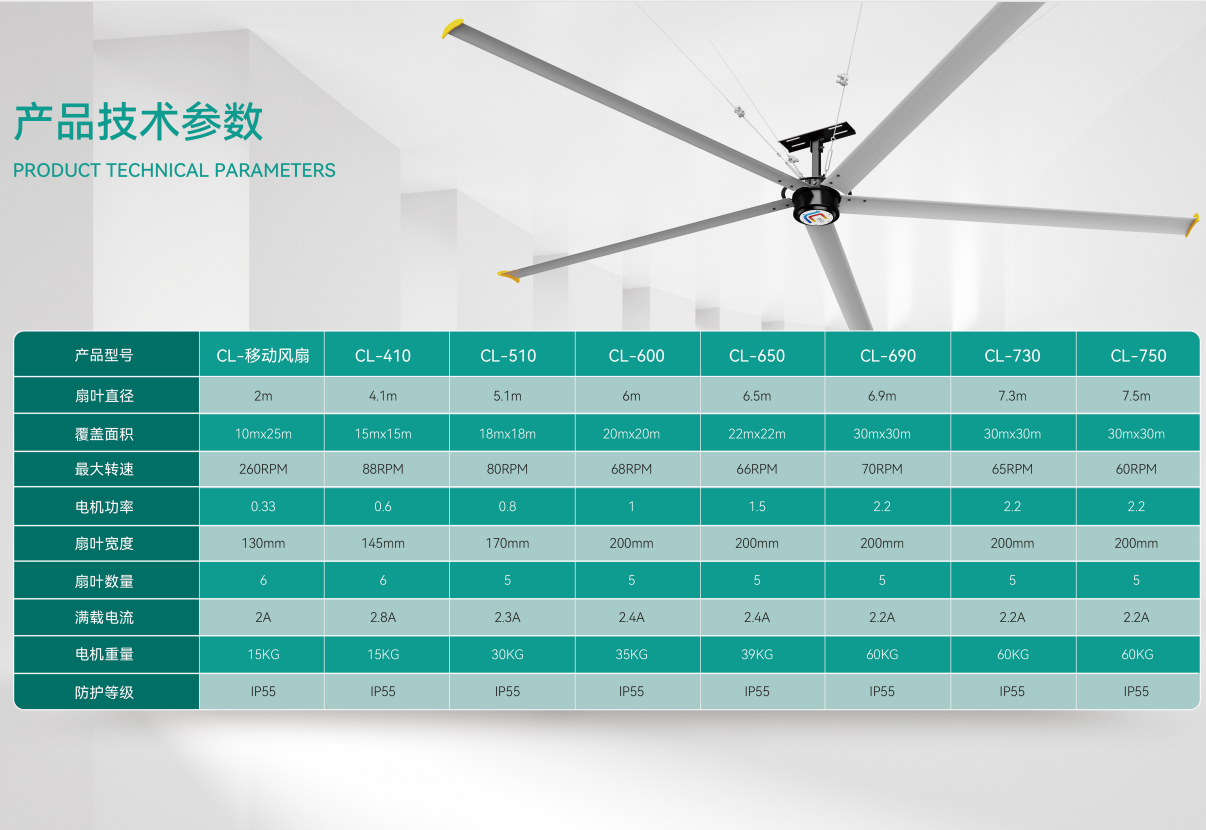
The following are the main usage characteristics of industrial fans, which can be divided into several aspects:
1、 The unique experience brought by the core working principle
Three dimensional breeze, fully covering:
Features: Industrial large fans (usually with a diameter between 4-7.3 meters) can push a large amount of air, forming a three-dimensional gentle airflow of 1-3 meters per second. This airflow is similar to a natural breeze, blowing from top to bottom towards the ground and flowing horizontally, forming a conical airflow layer, thus achieving all-round and no blind spots coverage of the workshop.
Comparison: Traditional small fans blow air in a "point" manner, and only the areas that are blown directly feel cool, with limited coverage.
Human body evaporation cooling, perceived coolness:
Characteristics: The key to industrial fans is not to lower the air temperature, but to accelerate the evaporation of sweat on the surface of the human skin through continuous gentle winds, thereby taking away heat and making the human body feel cool at 5-8 ℃. This is a very efficient and healthy way to cool down.
Comparison: Air conditioning is "cooling", while large fans are "making people feel cool", with vastly different energy consumption.
2、 Significant functional and benefit characteristics
The energy-saving effect is extremely significant:
Features: A large industrial fan with a diameter of 7.3 meters has a power of only 1.5 kilowatts, replacing dozens of traditional small fans in a huge space (up to 1500 square meters). The energy-saving effect is amazing, and the power consumption is only 5% -10% of that of central air conditioning.
Benefit: Significantly reduce the operating electricity costs of enterprises in summer.
Improving air quality, ventilation and air exchange:
Characteristic: It can break the stratification of stagnant indoor air and promote air mixing throughout the entire space. It can push the hot air stagnant on the roof towards the ground, mix it with cooler air, and at the same time discharge the polluted air outside the window, introducing fresh air.
Benefit: Solve problems such as stuffiness, odor, smoke, dust, etc., and provide a healthier working environment.
Dehumidification and moisture prevention, protection of equipment and products:
Characteristics: In humid environments such as warehouses, paper mills, and textile workshops, continuous air flow can accelerate the evaporation of moisture on the ground and object surfaces, effectively preventing product mold and equipment rust.
Benefit: Reduce inventory losses and maintain production equipment.
Winter auxiliary heating, balancing temperature difference:
Characteristic: In winter, hot air will gather on the roof (the higher the ground, the higher the temperature). The large fan can run at low speed in reverse, slowly pushing the hot air from the roof towards the ground, eliminating vertical temperature differences, and achieving energy-saving heating.
Benefit: Keeping ground workers warm and saving heating costs without increasing energy consumption.
3、 Application and environmental characteristics
Widely applicable space:
Features: Especially suitable for tall spaces such as logistics warehouses, production workshops, sports venues, supermarkets, waiting halls, breeding farms, etc. The higher the space, the better the effect.
Safe and reliable, low noise:
Features: The high-quality industrial fan adopts aviation grade materials and safety design (such as redundant protection, anti loosening, etc.), runs smoothly, has low noise, and will not interfere with workshop communication and production.
In summary, the core feature of industrial fans is that they do not "create coolness" through high energy consumption, but effectively "utilize" the environment itself through scientific airflow organization, bringing comprehensive improvements to personnel, products, and the environment, and then achieving a perfect combination of energy conservation, environmental protection, health, and effectiveness.


