 English

 English
The working principle of industrial fans is mainly based on aerodynamics and fluid dynamics. By slowly rotating large diameter fan blades, a large area of airflow is generated, thereby achieving efficient and energy-saving air circulation and cooling effects. The following is a detailed analysis of its core working principle:
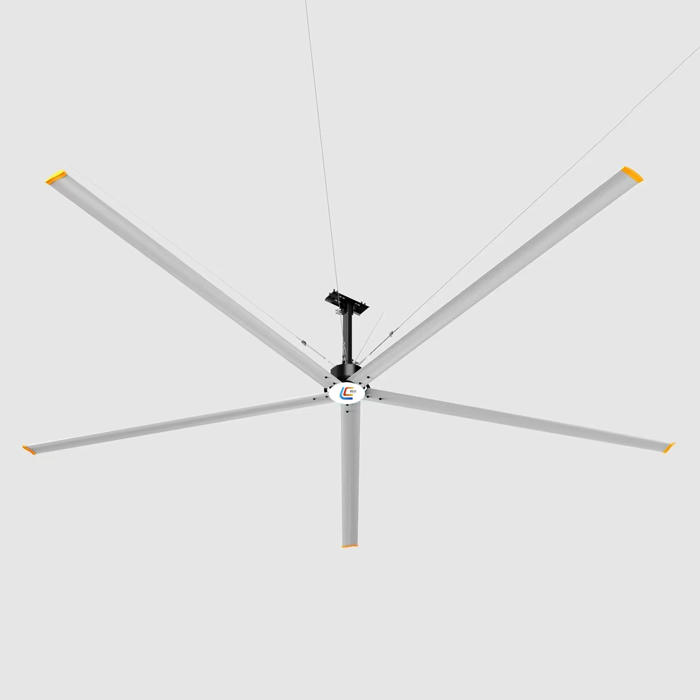
1. Basic operating principle
Large diameter low-speed rotation
The blade diameter of industrial fans is usually 3-7 meters, and the speed is controlled at 50-200 RPM (revolutions per minute). By operating at low speeds, energy loss and noise are reduced, while pushing a large amount of air to form a continuous airflow.
Airflow stratification and three-dimensional circulation
When the fan blades rotate, they push the stationary air above downwards, forming a vertical airflow; The horizontal direction generates horizontal flow due to the inclination angle of the fan blades (usually 5 °~15 °). This three-dimensional cycle can cover a diameter range of 20-30 meters.
2. Core aerodynamic effects
Mass Flow Rate effect
According to the formula Q=π R ² × V (Q is the air volume, R is the fan blade radius, and V is the wind speed), large diameter fan blades can drive a huge air volume even when running at low speeds (such as wind speeds of 1-3 m/s) (a single fan can reach an air volume of 10000~30000 m ³/min).
Coanda Effect
When the airflow flows along the surface of the fan blade, it will adhere to the curved surface and spray downwards at an inclined angle, enhancing the projection distance of the airflow. At the same time, the air near the ground is sucked up, creating a "fountain effect" that promotes air mixing throughout the entire space.
Human body evaporation cooling
Continuous airflow accelerates the evaporation of human sweat (when the wind speed is 1-2m/s, the perceived temperature can be reduced by 3-7 ℃), rather than directly reducing the ambient temperature, so the energy consumption is only 1/10~1/20 of air conditioning.
3. Power system and energy efficiency design
Efficient motor drive
Using permanent magnet synchronous motors (PMSM) or asynchronous motors with IE3/IE4 energy efficiency levels, the efficiency can reach over 90%. Some models are equipped with frequency converters to achieve stepless speed regulation (such as 20% to 100% load adjustment).
Fan blade wing optimization
The fan blades adopt an aviation airfoil profile (such as the NACA series) to reduce air resistance and enhance lift. The materials are mostly aluminum alloy or carbon fiber, balancing strength and lightweight.
4. Application scenario adaptation
Airflow organization in tall spaces
Suitable for environments with a floor height of 4-15 meters such as factories, warehouses, and sports venues, it eliminates hot air stratification through a "top-down" airflow to achieve a vertical temperature difference of ≤ 2 ℃.
Collaborate with ventilation/air conditioning systems
Can be linked with negative pressure fans and fresh air systems: the large fan is responsible for mixing air, while other devices are responsible for ventilation or cooling, reducing overall energy consumption by 30% to 50%.
5. Safety and stability design
Anti loosening structure
The fan blades are fixed with high-strength bolts and anti loosening washers, and have passed dynamic balance testing (residual unbalance ≤ 0.5g · m).
overload protection
The motor is equipped with a built-in temperature sensor, which automatically shuts down in case of overheating or abnormal current. Some models are equipped with redundant support structures (such as double wire rope anti fall devices).
Summary: Industrial large fans generate three-dimensional airflow through low-speed and large-diameter rotation, combined with the Kanda effect and evaporative cooling principle, to achieve efficient and energy-saving environmental regulation. The core of its technology lies in the collaborative optimization of aerodynamic design, efficient power systems, and intelligent control strategies.


