The core of selecting large fans for factory workshops is to "adapt to space, meet cooling and ventilation needs, and balance energy conservation and safety". Requirements need to be determined around four core dimensions: space parameters, usage scenarios, performance indicators, and installation safety.
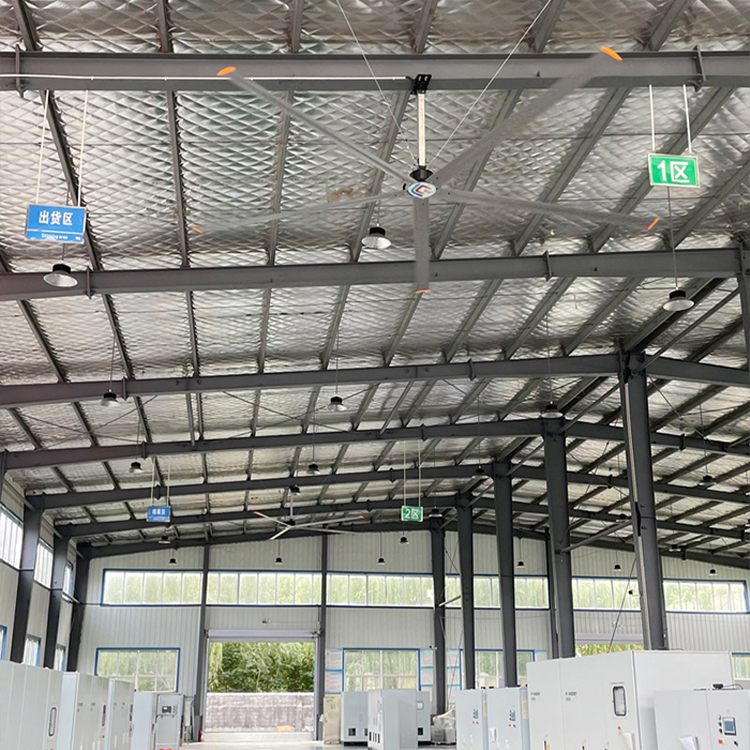
1、 Requirements for spatial parameter adaptation
Match blade size by area and height: For workshops with an area of 100-300 square meters, choose 6-7.3m blades. For workshops with an area of 300-500 square meters, choose 7.3-8.5m blades. For workshops with an area of over 500 square meters, it is recommended to combine multiple 8.5-10m blades for layout.
The floor height should be ≥ 4.5m (suitable for 6-15m), and any height below 4.5m may cause a sense of airflow compression. Additionally, the bottom of the fan blades should be ≥ 2.5m above the ground to avoid collision risks.
For large spaces with a span exceeding 20m, a "uniform distribution+staggered layout" is adopted, with each fan covering a radius of 15-20m to ensure no ventilation blind spots.
2、 Requirements for adaptation to usage scenarios
High temperature and stuffy workshops (such as casting and welding workshops): Priority should be given to high air volume (≥ 13000m ³/min) and high-speed models, paired with negative pressure fans to form air convection and quickly dissipate heat.
For workshops with dust/oil stains (such as mechanical processing and hardware workshops): choose fully sealed motors and anti-corrosion fan blades (made of aluminum alloy or fiberglass material) to prevent dust accumulation from causing malfunctions.
Personnel intensive workshops (such as assembly and packaging workshops): focus on low-noise (≤ 65dB) and gentle airflow models to avoid discomfort caused by strong winds blowing directly.
Low temperature/insulated workshops (such as storage and precision machining workshops): Choose adjustable wind speed models, which can be reversed in winter to promote hot air circulation and reduce energy consumption.
3、 Core performance indicator requirements
Airflow and wind speed: The air volume of industrial large fans should be ≥ 8000m ³/min, and the ground wind speed should be controlled at 0.3-1.5m/s, taking into account both cooling effect and comfort.
Energy saving: The preferred motor power is 1.5-3.0kW, with an energy efficiency rating of ≥ IE3, which saves more than 30% energy compared to ordinary fans and is more economical for long-term operation.
Durability: The fan blades need to undergo dynamic balance testing (deviation ≤ 0.5g), motor protection level ≥ IP54 (dustproof and waterproof), and service life ≥ 10 years.
Control function: Supports stepless speed regulation and timed switching. For large workshops, it is recommended to choose linkage control (synchronous adjustment of multiple machines) for convenient unified management.
4、 Installation and safety requirements
Installation load bearing: The fan installation point (beam, steel frame) should be able to withstand a load of ≥ 5 times the weight of the fan (including operating vibration), and reinforced steel plates should be added if necessary.
Safety protection: Equipped with anti fall devices (such as double safety wire ropes), fan blade protective nets, and motors with overheat protection and overload protection functions to avoid accidental failures.
Installation environment: Avoid obstacles such as fire pipes and cable trays, and ensure that the distance between the edge of the fan blade and the obstacle is ≥ 1.5m. Explosion proof motors should be selected in damp workshops to meet safety regulations.


