Industrial fans are not idle equipment in winter, and their proper use can actually solve the common temperature stratification problem in tall spaces and improve heating efficiency. Below, we will introduce the principles, functions, usage methods, and precautions from several aspects.
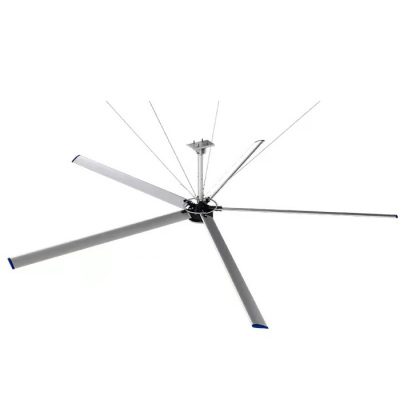
From a principle perspective, a low density of hot air will naturally increase. In spaces with high ceilings such as steel structure factories and large warehouses, warm air often gathers near the roof, while personnel activity areas remain relatively cold. Industrial fans use ultra large diameter blades to rotate at low speed, pushing air to form a vertical circulation, conveying warm air gathered at the top downwards and mixing it with cold air on the ground, thereby reducing the temperature difference between the upper and lower parts.
The main functions of winter use are reflected in several aspects. One is to improve heating efficiency. When used in conjunction with heating or hot air equipment, it can evenly distribute heat to the personnel activity area, reducing energy waste. The second is to improve physical comfort, eliminate the phenomenon of hot head and cold feet, and make the temperature in the work area more uniform. The third is to prevent condensation and moisture. Air flow can reduce condensation on roofs and structural surfaces, reducing the risk of rust and mold. The fourth is to maintain air quality and avoid the accumulation of polluted air in enclosed spaces during winter.
There is a significant difference in usage between winter and summer. In summer, fans usually blow downwards with high wind speed, which directly brings a cool feeling. In winter, it is recommended to operate at low speed and adjust the airflow direction to upward or reverse. First, stir and mix the hot air at the top, and then slowly circulate downwards to avoid discomfort caused by strong winds blowing directly on the human body. Most industrial fans support forward and reverse rotation and variable frequency speed regulation, and can be set to a lower speed gear in winter to achieve gentle air circulation.
In terms of temperature setting, it is generally suitable to turn on the fan for mixing when there is a large temperature difference between indoors and outdoors, or when the temperature difference between the top and the ground exceeds three to five degrees Celsius. If the factory is equipped with heating equipment, the fan should be linked with the heating system and run continuously at low speed during the heating process to make the heat distribution more uniform. In places without centralized heating, fans can improve body sensation through air flow, but they cannot replace heat sources.
In terms of operating time, it does not need to be turned on all day in winter, and can be operated in different time periods according to production shifts and temperature changes. For example, starting in advance before work and coordinating with heating equipment to preheat the space; Maintain low-speed circulation during the production process; Close after work. This can ensure both effectiveness and save electricity consumption.
In terms of precautions, the first thing to avoid is high-speed direct blowing. In winter, the human body is sensitive to cold winds, and strong winds can exacerbate the feeling of coldness. Secondly, it is necessary to confirm that the fan has the function of reversing or adjusting the wind direction, otherwise the effect of winter use will be limited. Regularly check the safety devices again. The low temperature in winter may affect the performance of some components. The steel wire rope, anti fall device, and electrical circuit need to be confirmed to be normal. In addition, if there is dust or corrosive gas in the factory, it is even more important to pay attention to fan cleaning and maintenance when ventilation is reduced in winter. Winter use should be combined with the insulation condition of the building. If the sealing and insulation of the factory building are poor, the function of the fan will be compromised. If necessary, the enclosure structure should be improved first.
Overall, the core value of industrial fans in winter is to break temperature stratification, evenly distribute heat, and improve heating efficiency. The correct approach is to operate at low speed, adjust the wind direction, coordinate with the heat source, use in different time periods, and conduct safety checks. This not only makes the winter workshop more comfortable, but also reduces heating energy consumption and extends the annual use value of equipment.


