 English

 English
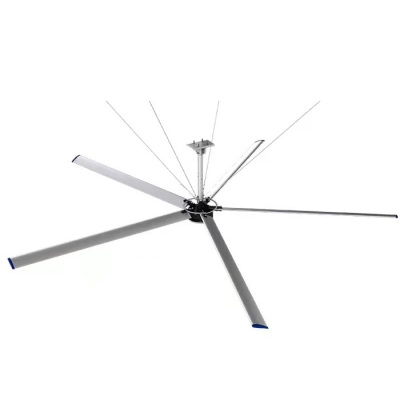
Industrial energy-saving large fans (usually referring to large low-speed fans with a diameter of 3.7 meters or more) have significant effects in industrial environments, especially in ventilation and cooling, energy conservation and consumption reduction, and improving environmental comfort. The following is an analysis of its specific effects:
1. Cooling effect
Sensory cooling: By using large-diameter fan blades to push a large amount of air flow, a three-dimensional breeze circulation is formed, accelerating the evaporation of human sweat. The perceived temperature can be reduced by 5-8 ℃, but the actual ambient temperature remains unchanged, making it suitable for high-temperature workshops, warehouses, and other places.
Wide coverage: The model with a single fan diameter of 7.3 meters can cover an area of about 1500 square meters (when the height is 4-6 meters), with soft and uniform wind speed, avoiding the discomfort of traditional small fans blowing directly.
2. Energy saving advantages
Low power and high energy efficiency: The power is usually only 1.1-1.5kW (equivalent to the total power of 10 traditional small fans), reducing energy consumption by 50% -80%.
Reduce dependence on air conditioning: When used in conjunction with air conditioning, the set temperature of the air conditioning can be increased by 2-4 ℃, saving 20% -30% of air conditioning energy consumption.
Long life design: Superior motors and aviation aluminum fan blades have a lifespan of over 10 years and low maintenance costs.
3. Ventilation and air exchange effect
Improving air quality: promoting air circulation in the space, eliminating stuffy air, dust, and odors, reducing harmful gas concentrations (such as CO ₂, formaldehyde), especially suitable for welding workshops, spraying workshops, etc.
Moisture and mold prevention: Reduce the retention of humid air in the storage environment to prevent the goods from becoming moldy.
4. Comparison of applicable scenarios
Scene effect
High rise spaces such as logistics warehouses and factories (with a floor height of 4-15 meters) solve the problem of hot air stratification and achieve uniform cooling.
Personnel intensive areas such as assembly workshops and canteens can quickly improve comfort and reduce the risk of employee heatstroke.
Auxiliary cooling equipment in the equipment cooling area (such as injection molding machines, boiler rooms), but it is necessary to avoid interfering with the original airflow.
Open spaces such as sports halls and waiting halls, combined with natural ventilation, have better results.
5. Limitations
Environmental dependence: In extremely high temperatures (>40 ℃) or enclosed environments without ventilation, other cooling devices need to be used in conjunction.
The initial investment is relatively high: the price per unit is about 10000 to 30000 yuan, but the long-term energy-saving return rate is high (usually 1-3 years to recoup the cost).
Installation conditions: It is necessary to ensure the roof load-bearing capacity (≥ 150kg) and height (fan blade to ground distance ≥ 3 meters).
6. User feedback cases
A certain automobile parts factory: After installing 8 7.3-meter fans, the workshop temperature in summer decreased from 36 ℃ to 28 ℃, saving about 120000 yuan in annual electricity bills.
E-commerce warehouse: Replace the original small fans, reduce energy consumption by 60%, and decrease employee complaint rate by 70%.
Conclusion
Industrial energy-saving large fans are suitable for places with large spaces, dense personnel, and poor ventilation, and have significant effects on comprehensive cooling, energy saving, and ventilation needs. But it is necessary to choose the model and layout according to the specific scenario (area, floor height, heat source distribution), and consult professional suppliers for airflow simulation design if necessary.


