 English

 English
The role of industrial energy-saving large fans in summer cooling is indeed crucial, especially in high-rise spaces, densely populated or high-temperature working environments. Through effective airflow organization, they achieve sensory cooling, energy saving and consumption reduction, and air circulation, with comprehensive value far exceeding traditional cooling equipment.
1、 Core cooling principle
Three-dimensional airflow circulation
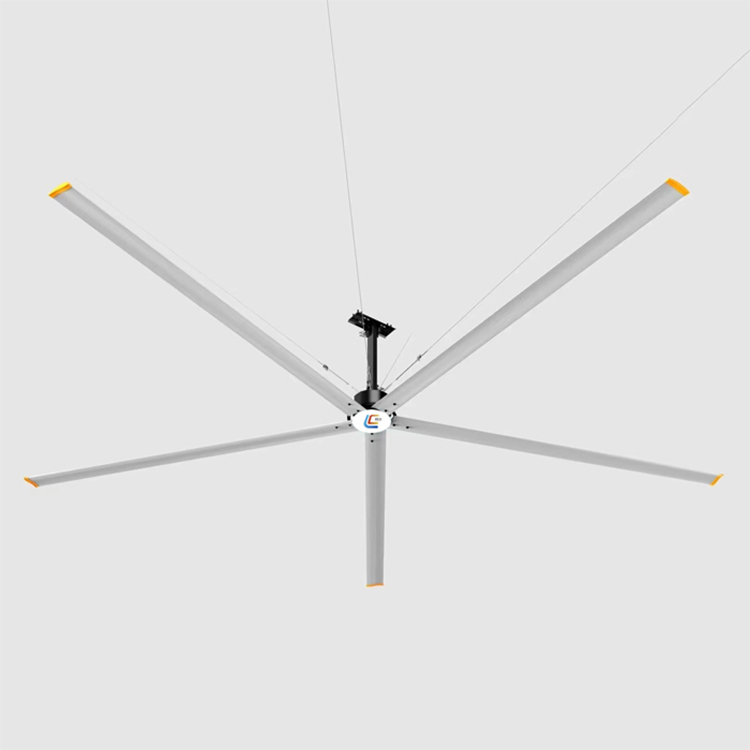
Large diameter fan blades (usually 4.7-7.3 meters) rotate slowly (at a speed of 20-50 RPM), pushing a large amount of air to flow downward, forming a vertical "conical airflow", and then spreading horizontally along the ground, creating 1-3 levels of natural breeze.
Effect: The coverage area can reach 1500 square meters (per unit), avoiding the locality of traditional fans blowing directly and achieving uniform cooling throughout the entire area.
Evaporative cooling effect
Airflow accelerates the evaporation of human sweat (wind speed of 2-3m/s), reducing the perceived temperature by 5-8 ℃, while the actual ambient temperature only needs to decrease slightly (1-2 ℃ can improve comfort).
2、 The core advantage of summer cooling
1. Solve the problem of thermal stratification in high-rise spaces
Problem: During high temperatures in summer, hot air accumulates on the roof (up to 40 ℃+), while the ground temperature is lower, forming a temperature gradient (about 1-2 ℃ difference for every 1 meter increase).
Solution: The large fan continuously stirs the hot air at the top to mix with the ground, breaking the stratification and making the space temperature uniform (the temperature difference can be reduced by more than 70%).
2. Energy saving and effective, reducing overall costs
Energy consumption comparison: 1 7.3-meter fan (1.5kW) ≈ 10 traditional industrial fans (0.75kW × 10=7.5kW), reducing power consumption by 80%.
Air conditioning coordination: When used in conjunction with air conditioning, the set temperature of the air conditioning can be increased by 2-4 ℃, reducing the air conditioning load by 20% -30% (Example: A workshop air conditioning set at 28 ℃+fan ≈ original 26 ℃ perceived).
3. Improve the high-temperature working environment
Personnel intensive areas (such as assembly lines and canteens): Continuous gentle breeze reduces employees' heat stress response, reduces heatstroke and fatigue, and improves work efficiency by 10% -15% (International Labour Organization data).
Equipment cooling area (such as boiler room, computer room): auxiliary equipment cooling to avoid local overheating and malfunction.
3、 Comparison of typical application scenario effects
Pain points of traditional scene solutions, energy-saving fan solutions
The logistics warehouse (with a floor height of 8m) has accumulated heat at the top, and the ground is stuffy. The air conditioning is ineffective, and three 7.3-meter fans achieve full coverage, resulting in a perceived cooling of 6 ℃
Smoke and dust accumulation in the welding workshop, poor ventilation fan+smoke exhaust system linkage, air exchange rate increased by 3 times
The energy consumption of air conditioning in the gym is high, and the slow sinking fan promotes the diffusion of air conditioning, reducing the running time of air conditioning by 40%
4、 Actual case data
A certain automobile manufacturing plant (workshop area of 5000 square meters, floor height of 10m):
After installing 6 7.3-meter fans, the average perceived temperature in summer decreased from 34 ℃ to 27 ℃, saving an annual electricity fee of 180000 yuan (compared to the original air conditioning+small fan solution).
Agricultural product cold storage loading and unloading area:
The fan cooperates with the spray system, and the humidity is kept at 60%. At the same time, the temperature in the working area of workers is reduced from 38 ℃ to 31 ℃, and the corrosion rate of goods is reduced by 25%.
5、 Precautions
Installation design:
Height requirement: The fan blades should be at least 3 meters above the ground, with a spacing of 2-3 times the diameter of the fan (ensuring overlapping airflow).
Avoid obstacles such as beams and pipes, otherwise the airflow will be obstructed.
Environmental adaptation:
Extremely high temperatures (>40 ℃) or enclosed spaces require the use of water curtains and air conditioning.
Explosion proof motors or regular cleaning of fan blades are required for environments with excessive dust.
VI. Conclusion
Industrial energy-saving large fans are an irreplaceable and cost-effective solution for summer cooling, especially suitable for:
Tall space (with a floor height of 4-15 meters)
Open or semi open areas (such as warehouses, platforms)
Places that require rapid improvement of perceived temperature
Its characteristics of low energy consumption, wide coverage, and long lifespan make it a preferred tool for summer cooling in the industrial field. It is recommended to choose professional brands (such as Hunter, Big Shepherd, etc.) and optimize layout design based on specific scenario requirements to maximize benefits.


