 English

 English
The industrial energy-saving fan, with its unique design and working principle, has shown significant advantages in cooling, ventilation, energy saving and consumption reduction in high-rise spaces. The following is a detailed analysis of the core characteristics of the factory's large fan:
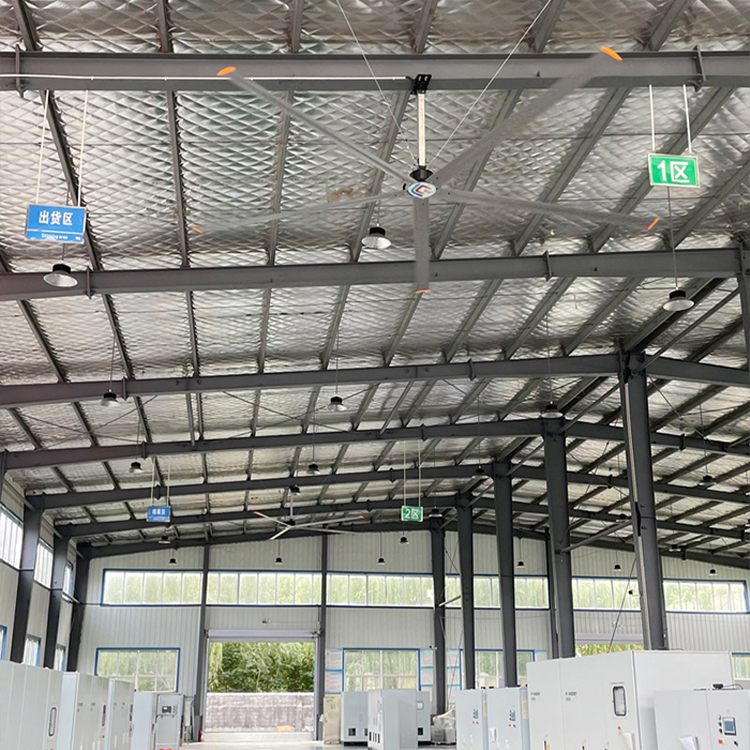
1. Large coverage area, effective airflow organization
Large diameter (usually 4.7-7.3 meters): A single fan can cover 800-1500 square meters (when the floor height is 4-6 meters), with gentle wind speed (1-3m/s), forming a three-dimensional circulating airflow.
Three dimensional cooling: The airflow is pushed from top to bottom, spreads horizontally along the ground, and then rises to the roof, breaking the stratification of hot air (solving the problem of roof heat accumulation).
Compared to traditional fans: 10 0.75kW small fans cover an area of ≈ 1 1.5kW large fan, and the latter has no discomfort when blowing directly.
2. Ultra low energy consumption, long-term energy saving
Low power: only 1.1-1.5kW (equivalent to a household air conditioner), with a 24-hour electricity bill of less than 20 yuan.
Energy saving mode:
When used independently, energy consumption is reduced by 50% to 80% compared to traditional fan groups;
When combined with air conditioning, the set temperature of the air conditioning can be increased by 2-4 ℃, saving 20% to 30% of air conditioning power consumption.
Return cycle: The initial investment is about 10000 to 30000 yuan per unit, and the cost is usually recovered through electricity bills within 1-3 years.
3. Durable and easy to maintain
Material:
Fan blade: aviation grade aluminum alloy or reinforced fiberglass (corrosion-resistant, anti deformation);
Motor: IP55 protection level (dustproof and waterproof), superior copper wire winding.
Lifespan: The design lifespan is 10-15 years (12 hours of daily operation), and the bearings need to be lubricated every 3 years.
Silent design: The noise level is less than 50dB (similar to indoor conversation sound), far lower than the roar of small industrial fans.
4. Improve comprehensive environmental indicators
Functional effect
The perceived temperature drops by 5-8 ℃, while the actual temperature drops by 1-3 ℃ (through sweat evaporation for heat dissipation).
The ventilation volume is increased by 3-5 times, reducing the accumulation of dust, CO ₂, and formaldehyde (such as a 40% decrease in PM2.5 in welding workshops).
Moisture and mold prevention accelerate air flow and reduce humidity by 10% to 15% (applicable to storage environments).
Safety enhancement to avoid messy wires of small fans and reduce the risk of electrical leakage; No exposed high-speed rotating parts (low-speed design).
5. Intelligent control and flexibility
Control method:
Standard speed regulator (3-5 speed adjustment);
Optional temperature and humidity sensors, timing switches, or IoT remote control.
Installation adaptability:
Fixed methods: roof suspension, column type or mobile bracket;
Suitable for roofs: steel structures, concrete beams (with a load-bearing capacity of ≥ 150kg).
6. Limitations and countermeasures
Not applicable scenarios:
Spaces with a floor height of less than 3 meters (where airflow cannot be fully diffused);
Extremely high temperature (>45 ℃) or enclosed windowless environment (requires water curtain/air conditioning).
Installation requirements:
A professional team is required to design the layout (to avoid dead corners of airflow);
Obstacles (such as beams) need to be at least 1 meter away from the fan blades.
7. Comparative advantages with traditional equipment
Indicator Factory Large Fan Traditional Industrial Fan Air Conditioning
Coverage area: 1500 square meters per unit, 50-100 square meters per unit, dependent on quantity, high cost
Energy consumption 1.5kW/unit 0.75kW/unit (multiple units required) 10-50kW/unit
The cooling method includes sensory cooling and local direct ventilation for actual cooling, but it consumes high energy
The maintenance cost is very low (annual maintenance fee ≈ 100 yuan/unit), high (motor vulnerable), and very high (refrigerant and filter replacement)
8. Suggestions for typical application scenarios
Priority selection:
Logistics warehouse (with a height of 6-12 meters), large workshops (such as automobile manufacturing and textile), sports arena, and agricultural and livestock greenhouses.
Use with caution:
Quasi confidential instrument workshop (requiring dust and shock prevention), low-temperature cold storage (may affect insulation).
summary
The core characteristics of a factory fan are "large coverage, low energy consumption, long lifespan, and multifunctionality", especially suitable for solving the summer cooling problem in tall spaces. Its comprehensive cost-effectiveness far exceeds traditional equipment, but it needs to be selected and laid out reasonably according to specific scenarios (area, floor height, heat source distribution). It is recommended to choose professional brands (such as Hunter, Big Shepherd, Rite Hite) and provide on-site airflow simulation solutions to maximize efficiency.


