 English

 English
Tall factories (such as aircraft maintenance garages, automobile manufacturing workshops, logistics sorting centers, and large sports halls) have long faced a "long-standing problem": heating floats on the roof in winter, and ground personnel have cold feet; In summer, the hot air accumulates in the dome, making the ground stuffy and unbearable. Traditional axial flow fans or central air conditioning systems either consume an astonishing amount of energy or have minimal effectiveness in spaces over 8 meters high.
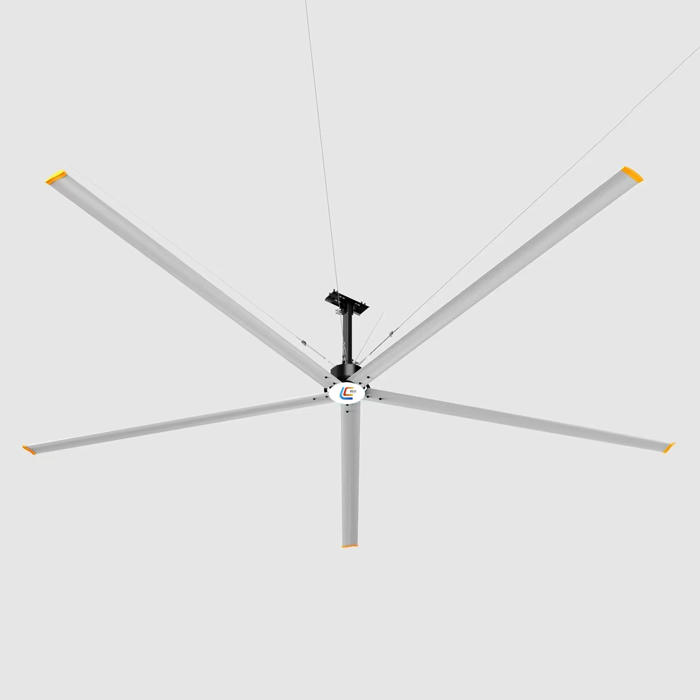
The emergence of industrial energy-saving ceiling fans (with diameters up to 7.3 meters or even larger) is systematically optimizing the air supply performance of tall factories based on disruptive aerodynamic principles. It not only solves the problem of "blowing", but also the structural defects of temperature and humidity stratification, dead corners of airflow, and energy waste in the entire space.
The optimization mechanism is analyzed from four dimensions:
1、 Thoroughly breaking the 'temperature gradient' and achieving uniform temperature throughout the entire space
The significant thermal defect of tall factory buildings is severe vertical temperature stratification. The density of hot air is low, naturally rising to the roof, causing the roof temperature to reach as high as 40-50 ℃, while the ground work area may only have 10-15 ℃ (in winter) or unbearable stuffiness (in summer).
The limitations of traditional solutions: wall mounted axial fans can only push horizontally and cannot "pull" the hot air from the roof; The air conditioning system requires a huge amount of energy to cool the accumulated heat on the roof, which is extremely inefficient.
The optimization logic of a large ceiling fan: The large-diameter fan blades rotate at low speed (usually 20-50 revolutions per minute), producing not a straight blowing "hard wind", but a three-dimensional cylindrical airflow that covers the entire cross-section. This airflow slowly advances from top to bottom, and after reaching the ground, it spreads evenly in all directions, forming the "mushroom cloud effect". This process forces the accumulated hot air on the roof to be "pressed" back into the ground work area, rapidly reducing the vertical temperature difference from the original 8-12 ℃ to within 2-3 ℃.
Actual effect: In winter, the large ceiling fan reverse mode is activated to force the hot air from the roof downwards, greatly improving the heat utilization efficiency of underfloor heating or radiators, and reducing heating energy consumption by 20% -30%.
2、 Eliminate the 'vortex dead zone' and improve overall air exchange efficiency
In large workshops spanning tens of meters, corners that are difficult to reach with natural ventilation (such as areas blocked by tall equipment) are often vortex dead zones. These places have stagnant air, accumulated dust, and unpleasant odors, which seriously affect product quality and worker health.
Optimization mechanism: The diameter of the large ceiling fan determines its maximum turbulence radius (a single unit can cover an area of 1000-1500 square meters). The low-speed high flow airflow generated by it (with an air volume of over 15000 cubic meters per minute) can effectively "stir" the entire indoor air mass. Dead zone air is carried and replaced by continuous macroscopic airflow, participating in the overall exchange of the entire space. The air exchange rate can be increased by 1-2 times per hour on the basis of natural ventilation.
Joint benefits: Combined with non powered ventilation balls on the roof or side wall exhaust fans, the large ceiling fan can continuously push the turbid air at the bottom towards the roof exhaust outlet, forming a synergistic effect of "positive pressure air supply+negative pressure exhaust", greatly improving the overall air quality of the factory building.
3、 From "fixed-point cooling" to "sensory cooling", it makes great use of evaporative heat dissipation
In summer, the human body uses sweat evaporation to dissipate heat. But if the ambient air velocity is too low (<0.3m/s), the surface thermal boundary layer is difficult to break, and people will feel "stuffy".
The advantage of a large ceiling fan is that it does not provide low temperature air like air conditioning, but a continuous and uniform wind speed field (the effective ground wind speed is usually controlled between 1-3m/s). According to the ASHRAE (American Society of Heating, Ventilation, and Air Conditioning Engineers) thermal comfort theory, for every 1m/s increase in wind speed at the same temperature and humidity, the perceived temperature can be reduced by 2-3 ℃.
Optimization value: This means that in summer, even if the workshop temperature is still 32 ℃, within the coverage area of the large ceiling fan, the human body sensation is only 28-29 ℃. This effect allows factories to delay the start of air conditioning or directly replace local air conditioning units, saving a considerable amount of electricity costs (the power of the large ceiling fan itself is only 1-3kW, far lower than the power of central air conditioning, which can easily reach hundreds of kilowatts).
4、 Accurate adaptation to variable working conditions, flexible air supply without disturbing the process
High rise factories often have special working conditions such as crane lifting, precision machine tool processing, and flammable material stacking, which have strict requirements for the direction and intensity of airflow.
The flexibility of large ceiling fans: Modern intelligent large ceiling fans are equipped with variable frequency speed controllers, which can adjust the speed in real time according to the heat generation of equipment in the workshop, personnel density, and outdoor temperature. Increase the speed in areas with high worker density to enhance heat dissipation, and decrease the speed in precision measurement areas to avoid dust.
Controllable air supply direction: By controlling the rotation direction (forward to summer downwind and reverse to winter upwind), the dual working condition optimization of "providing warmth in winter and cooling in summer" can be achieved. And the airflow generated by low-speed operation is extremely gentle, which will not blow over lightweight paper or affect the welding gas protection layer, which traditional high-pressure axial fans cannot achieve.
5、 Quantitative manifestation of comprehensive air supply performance improvement
Taking a certain automobile stamping workshop (with a span of 120 meters x 60 meters and a net height of 12 meters) as an example, after installing 10 large ceiling fans with a diameter of 7.3 meters:
Temperature uniformity: The vertical temperature difference decreases from 9 ℃ to 2.5 ℃;
Air age (freshness): The average air age has decreased from 28 minutes to 16 minutes;
Human thermal comfort PMV index: improved from+2.2 (thermal) to+0.8 (slightly warm);
Annual comprehensive energy consumption: Compared with the original "axial flow fan+local air conditioning" scheme, the energy-saving rate reaches 45%.
Conclusion: It's not about replacing air conditioning, but about reshaping the "breathing style" of space
The optimization of the air supply performance of industrial energy-saving ceiling fans for tall factories is not simply about using wind power to counteract temperature, but rather utilizing the enormous turbulence capacity to reconstruct the air circulation logic of the entire building space. It has transformed the static thermal environment where only the roof participates in ventilation into a dynamic thermal balance where the ground and roof frequently communicate.
For managers, this is not just about buying a fan, but a set of building energy-saving renovation plans with a very short investment payback period (usually 1-2 years). When you see that although the ground thermometer reading has not dropped sharply, the workers' sweatshirts have dried, complaints have decreased, and the quality inspection pass rate has increased, this is a real and powerful proof of the optimization of the air supply performance of the large ceiling fan.


