Traditional solutions either treat the symptoms without addressing the root cause, or have exorbitant costs. In recent years, industrial ceiling fans have entered Anhui factories in large quantities, systematically solving the long-standing problem of stuffy ventilation that has plagued managers in a nearly disruptive way.
1、 Where is the root cause of the stuffiness in Anhui factory buildings?
To solve a problem, one must first recognize its essence. Anhui factory buildings are stuffy and have obvious regional characteristics compared to other regions:
The combination of plum rain and high temperature: During the plum rain season from June to July every year, the relative humidity of the air often exceeds 85%. At this point, human sweat cannot effectively evaporate, and even if the temperature is only 32 ℃, the body feels like 38 ℃. The "hot air" blown by traditional fans only accelerates the evaporation of moisture on the surface of the skin, but the effect is greatly reduced in high humidity environments.
The "heat absorption heat storage" effect of color steel tiles: A large number of steel structure factories in Anhui use color steel tile roofs, and under direct sunlight, the surface temperature of the roof can reach over 60 ℃. Heat is directly transferred downwards through thermal radiation, forming the "heat island effect" in the ground work area.
Natural ventilation conditions are limited: many old factory buildings have few windows and are difficult to open at high positions due to rain and dust prevention. They rely solely on roof air ducts or side wall axial flow fans to exhaust, and the incoming air volume is far from sufficient to replace the accumulated hot air indoors. There is always an indelible smell of engine oil and a dull feeling in the workshop.
2、 How to "break through" the situation after the industrial ceiling fan enters the market?
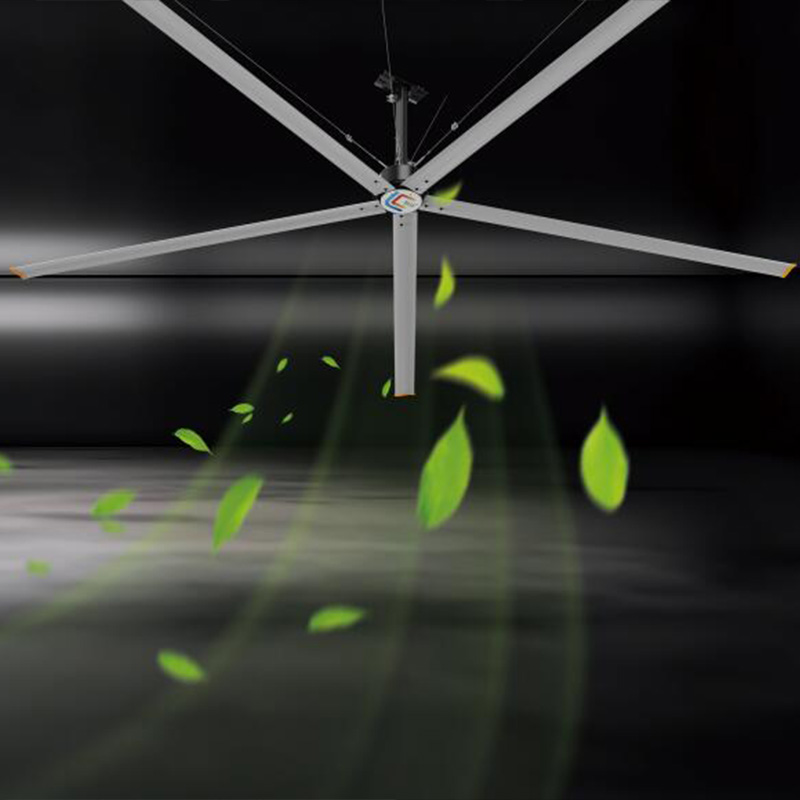
When an industrial ceiling fan with a diameter of 7.3 meters slowly starts in the center of the workshop, it brings not a gust of wind, but a complete air reorganization plan.
1. Force "up and down exchange" to break temperature stratification
The net height of most factories in Anhui is between 8-12 meters. Actual measurement data shows that on sunny afternoons in summer, the temperature at 1 meter below the roof can reach 45 ℃, while the temperature in the working area 1.5 meters above ground is 33 ℃ - a vertical temperature difference of 12 ℃. Hot air gathers all over the head, while cold air sinks beneath the feet with nowhere to replenish.
When the large ceiling fan is in operation, the huge fan blades rotate at a low speed of 20-50 revolutions per minute, forcing the hot air from the roof down to the ground, while the relatively cooler air from the ground is pushed upwards. This "up and down exchange" can compress the vertical temperature difference from 12 ℃ to within 3 ℃ within 20 minutes. The workers' intuitive feeling is that their heads are no longer "roasting anxiously".
2. Strengthen evaporative heat dissipation to combat high humidity environments
During the rainy season in Anhui, the value of large ceiling fans is particularly prominent. It provides a gentle airflow of 1-3 meters per second, which can continuously destroy the moisture boundary layer on the surface of the human body, allowing sweat to evaporate effectively in high humidity environments. According to the thermal comfort theory, for every 1 meter/second increase in wind speed, the perceived temperature can decrease by 2-3 ℃. This means that in a high-temperature workshop with a temperature of 35 ℃, the workers' physical sensation is equivalent to 32 ℃ or even lower, effectively avoiding the risks of heatstroke and fatigue during work.
3. Eliminate vortex blind spots and replace turbid air
Many old factory areas in Anhui have dense equipment, narrow forklift passages, and corners that cannot be covered by axial flow fans have stagnant air all year round. The disturbance radius of the large ceiling fan can reach 15-20 meters, and the three-dimensional columnar airflow generated can reach every corner of the workshop, continuously pushing the accumulated dust, welding fumes, and paint smell towards the roof exhaust outlet, forming a coordinated smoke exhaust with the air tower, greatly improving the breathing environment of workers.
4. Extremely low energy consumption, meeting the cost reduction needs of Anhui enterprises
The profit margin of Anhui's manufacturing industry is generally not high, and energy consumption cost is a sensitive indicator. A large ceiling fan covering an area of about 1500 square meters, with a power of only 1.5 kilowatts, consumes 12 kilowatt hours of electricity after 8 hours of operation, and the electricity bill is less than 10 yuan. Compared to using a central air conditioner (with a power of several hundred kilowatts) that requires the same area of air supply, the energy-saving rate can reach over 90%. For a two shift workshop, the electricity saved in one summer is enough to recoup the equipment investment.
3、 Unique considerations for local installation in Anhui
Industrial ceiling fans entering Anhui are not something that can be bought and hung. The local climate and architectural characteristics in Anhui have special requirements for installation:
Structural reinforcement must be in place: The roofs of light steel factories built in early Anhui were mostly made of C-shaped steel or Z-shaped steel, with limited bearing capacity. Before installation, a structural engineer must conduct on-site exploration and, if necessary, add H-beam conversion beams or C-shaped steel clamps to ensure the safe transmission of dynamic loads during the operation of the ceiling fan to the main structure. The first step for legitimate manufacturers to enter the site is to conduct bearing capacity verification and calculation, and never blindly install.
Lightning protection grounding and electrical specifications: Thunderstorms occur frequently in Anhui during summer, and the metal casing of large ceiling fans must be reliably grounded. Surge protectors must be installed in the frequency conversion control cabinet. When entering the construction site, the electrical wiring should avoid the sliding contact lines of the train and the fire pipes, in accordance with the GB 50054-2011 low-voltage distribution design specifications.
Winter anti condensation strategy: Anhui's winter is humid and cold, and the reversing function of the large ceiling fan is particularly important. In winter, the reverse mode is activated to forcefully lower the accumulated hot air on the roof (formed by equipment heat dissipation), which can effectively prevent condensation water droplets from falling on the inner wall of the metal roof due to temperature differences, protecting products and equipment from moisture damage.
4、 Real comparison of Anhui enterprises before and after introduction (taking a home appliance sheet metal workshop in Hefei as an example)
Before entering the site (June 2024): The workshop covers an area of 8000 square meters. Before installing 8 large ceiling fans, 18 industrial floor fans will be used to disperse and blow. Floor fans have a high failure rate, loud noise, and can only cover a local area. The average temperature in the workshop is 34.5 ℃, and workers need to take a 15 minute break every hour of work. The daily output is reduced by about 12% due to the high temperature.
After entering the site (July 2024): 8 large ceiling fans were hoisted in place and operated for one week. Actual measurements showed that the vertical temperature difference in the workshop decreased from 11 ℃ to 2.8 ℃, the average ground wind speed was 1.8 meters per second, and the perceived temperature remained stable within 30 ℃. Workers have given feedback that they are "gasping for breath", with no increase in high-temperature subsidy spending but production capacity exceeding the same period last year. All 18 floor to ceiling fans have been removed, freeing up floor space and significantly improving forklift efficiency.
5、 Suggestions for entry for Anhui managers
If you are considering introducing industrial ceiling fans, the following three points are worth paying special attention to:
Choose based on "coverage area" rather than "quantity": do not blindly install too much. Standard factory buildings are recommended to be configured with a density of 120-150 square meters per unit, with priority given to covering the assembly lines, inspection areas, and loading and unloading areas where workers stay for a long time.
Choose the off-season for entry: It is recommended to arrange entry for construction in spring (March April) or autumn (October November), avoiding the peak production period in summer and the wet and cold period in winter. The installation process requires power outage operation, and the installation of a single unit takes about 4-6 hours. The overall construction can be carried out in sections without affecting the normal production rhythm.
Be sure to request the 'Dynamic Balance Testing Report': After installation and commissioning are completed, the construction party is required to provide vibration value testing data. Legitimate manufacturers will ensure that the vibration value is ≤ 1.8mm/s (national standard limit), which is the core guarantee for the long-term stable operation of the equipment without abnormal noise or shaking.
Conclusion
The entry of Anhui industrial ceiling fans is essentially a pragmatic choice to solve major pain points with low investment. It doesn't have fancy technological gimmicks, it relies on solid aerodynamic principles and excellent cost-effectiveness. When the rainy season comes again, you will find that the low and peaceful sound of fan blades rotating in the workshop is the confidence of the workers to work with peace of mind and output stable production efficiency
。


