Industrial energy-saving ceiling fans (usually with a diameter of 5.5m-7.3m) are widely used in large spaces such as factories, warehouses, and logistics centers due to their advantages of large coverage area and low energy consumption. The installation quality directly affects the operation safety and energy-saving effect. It is necessary to strictly follow the three core links of structural load-bearing evaluation, component assembly, and safety debugging. The specific operation process is as follows:
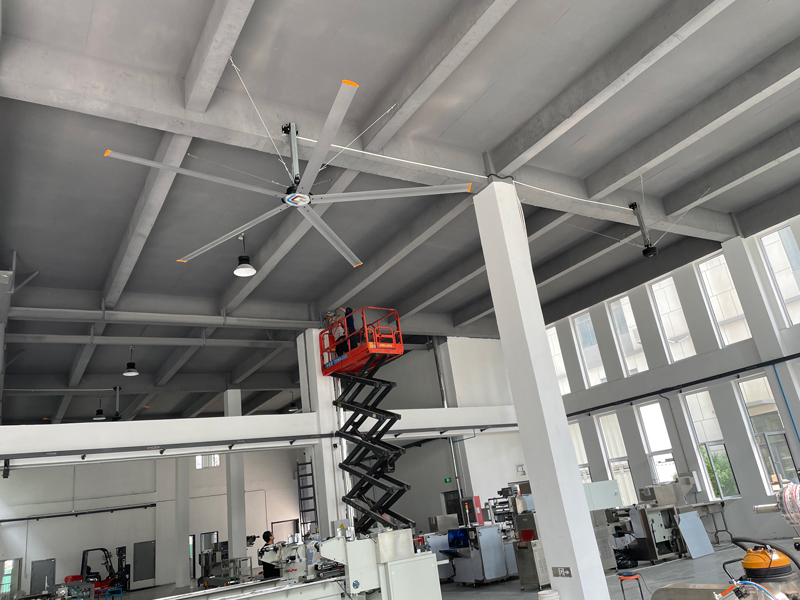
1、 Preparation and safety assessment before installation
Installation environment and load-bearing testing
Confirmation of load-bearing structure: Industrial ceiling fans need to be fixed on concrete main beams and steel H-shaped steel main beams, and are strictly prohibited from being installed on secondary beams, hollow floor slabs, or lightweight steel frames. Professional institutions need to be commissioned to test the load-bearing capacity, and the static load at the installation point must be ≥ 3 times the weight of the ceiling fan (including installation accessories), and the dynamic load must be ≥ 1.5 times.
Space environment investigation: Ensure that the rotation range of the ceiling fan blades is at least 50cm away from obstacles such as roof lamps, pipes, beams, and columns; the distance between the low point of the fan blades and the ground should be at least 2.8m to avoid contact by personnel.
Preparation of power and control circuits: Independent leakage protection switches and air switches are required. The specifications of the power lines should match the motor power (such as a 1.5kW motor with a 4mm ² copper core wire). The control circuits should be pre embedded in the installation position and treated with waterproof and moisture-proof measures.
Tool and accessory inspection
Essential tools: high-altitude work platform (or scaffold), torque wrench, level gauge, multimeter, wire rope tension meter.
Accessory verification: Check whether the ceiling fan host, blades, wheels, gearbox, installation bracket, expansion bolts (or steel structure special fixtures) and other accessories are complete, without deformation, cracks, rust and other defects; Verify that the accessory model matches the ceiling fan model.
2、 Core installation steps
Installation bracket fixation
Installation of concrete beams: Use high-strength chemical anchor bolts or expansion bolts to fix the installation base, with a drilling depth of ≥ 12cm. After the anchor bolts are implanted, they need to be left to solidify (usually ≥ 24h according to the anchor bolt instructions), and then use a torque wrench to check the tightening torque to ensure no looseness.
Installation of steel structure beams: Special steel structure fixtures (no welding required) are used to fix them on the H-shaped steel flange. The fixtures should match the steel beam model, and after tightening, they should be checked with a wrench to prevent slipping.
Horizontal calibration: Use a level to adjust and install the base, ensuring that the horizontal deviation of the base is ≤ 0.5 °, to avoid vibration caused by center of gravity deviation during the operation of the ceiling fan.
Main engine and gearbox hoisting
Use a forklift or manual hoist to lift the ceiling fan host (including the gearbox) below the installation bracket, and have professional high-altitude operators operate it to accurately connect the host flange with the installation bracket.
Tighten the connection parts with high-strength bolts, and the tightening torque should strictly follow the requirements of the product manual (usually 35-50N · m). The bolts should be equipped with anti loosening washers to prevent loosening during operation.
Blade assembly and angle adjustment
Blade installation: Connect the fan blades to the hub, and tighten the bolts symmetrically to avoid uneven force on one side; During installation, it is necessary to ensure that the blade surface is not damaged and that the connection gap between the blade and the hub is uniform.
Blade angle calibration: Use a dedicated angle ruler to adjust the installation angle of the fan blades (usually preset by the manufacturer as 12 ° -15 °), ensuring that all blade angles are consistent with a deviation of ≤ 0.5 °, otherwise it will cause excessive vibration and noise during operation.
Electrical system connection
Connect the motor power line and control line by a certified electrician, and distinguish between phase line, neutral line, and ground line. The ground line should be reliably grounded (grounding resistance ≤ 4 Ω) to prevent leakage accidents.
After the connection is completed, use a multimeter to check the insulation resistance of the motor winding, which should be ≥ 2M Ω, and confirm that there are no short circuits or open circuits.
3、 Commissioning and acceptance after installation
No load trial operation
Close the power switch, start the ceiling fan, run it at low speed for 10 minutes, and observe whether the fan blades rotate smoothly, without any abnormal noise, shaking, eccentricity, or other issues.
Switch between medium and high-speed operation in sequence, with each operation lasting ≥ 15 minutes. Use a vibration meter to measure the vibration value of the machine body, with a requirement of vibration speed ≤ 2.8mm/s; Simultaneously detect the temperature rise of the motor, and after running for 30 minutes, the temperature of the motor casing should be ≤ 70 ℃.
Safety protection and warning signs
Hang warning signs such as "No Climbing" and "No Stacking Materials Under Fan Leaves" below the ceiling fan.
Check if there are protective measures in the rotating area of the fan blades. If installed in densely populated areas, protective nets (mesh diameter ≤ 5cm) can be installed.
Acceptance and data archiving
Organize installation inspection reports, accessory qualification certificates, load-bearing inspection reports and other materials, and archive and retain them.
Train operators on the process of turning on and off the machine, daily inspection points, and emergency response methods.
4、 Installation precautions
The entire process must be operated by a professional installation team certified by the manufacturer, and construction by unqualified personnel is strictly prohibited; When working at heights, it is necessary to wear safety belts and helmets, and take measures to prevent falls.
It is strictly prohibited to step on the fan blades during installation to avoid blade deformation; The motor junction box needs to be sealed to prevent dust and moisture from entering.
Before operating the ceiling fan, all obstacles within the rotation range of the fan blades must be cleared. During trial operation, personnel are strictly prohibited from staying under the fan blades.


