Industrial exhaust fans are a major category, mainly divided into the following categories based on their structure and installation methods. Below, I will provide you with a detailed introduction to common models, key parameters, and selection guidelines.
1、 Main model classification
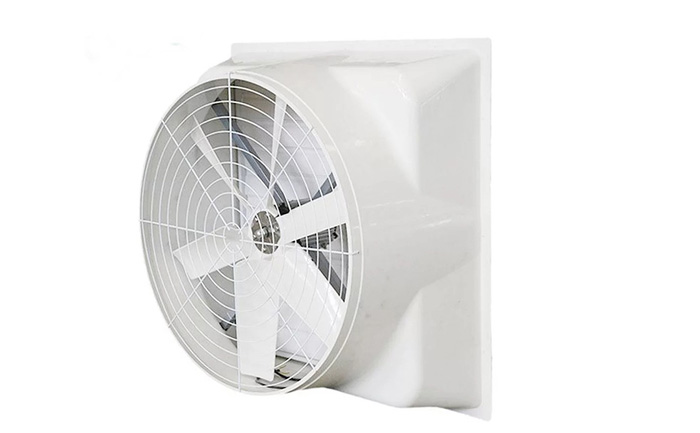
1. Axial flow exhaust fan
This is a common and economical industrial exhaust fan, where air is drawn in and out parallel to the fan axis direction.
Features: High air volume, low pressure, relatively low energy consumption.
Applicable scenarios: Factory workshops, warehouses, garages, public places, etc. that require large-scale ventilation and air exchange, but with low pipeline resistance.
Common models:
Side wall axial flow fan: directly installed on walls or windows.
Pipe type axial flow fan: installed in the ventilation duct.
2. Centrifugal exhaust fan
Air enters from the axial direction, turns 90 degrees inside the impeller, and is discharged radially by centrifugal force.
Features: high wind pressure, relatively loud noise, high energy consumption.
Applicable scenarios: occasions that require overcoming significant resistance, such as long-distance pipeline ventilation, air conditioning systems, exhaust gas treatment systems, kitchen fume exhaust, etc.
Common models (distinguished by impeller form):
Forward leaning centrifugal fan: high pressure, low cost, but relatively low efficiency, prone to overload.
Backward tilting centrifugal fan: high efficiency, stable power curve, less prone to overload, more energy-efficient, but higher cost.
3. Roof exhaust fan
Specially installed on the roof of buildings to directly discharge turbid hot air from indoors to outdoors.
Features: No need for air duct installation, directly effective. Usually comes with a rain cap to prevent rainwater from entering.
Applicable scenarios: steel structure factories, logistics warehouses, large shopping malls, sports venues, etc.
4. spray flow fan/circulating fan
Not used for exhaust, but for promoting large-scale circulation of indoor air, in conjunction with air conditioning or heating systems, to eliminate temperature and humidity stratification.
Features: Wide coverage and huge air volume.
Applicable scenarios: High rise spaces such as factories, gyms, storage centers, and large greenhouses.
2、 Detailed explanation of core performance parameters
When choosing an industrial exhaust fan, the following key parameters must be considered:
air volume
Definition: The volume of air delivered by a fan per unit of time.
Unit: cubic meters per hour (m ³/h) or cubic meters per minute (m ³/min).
Meaning: The core indicator that determines ventilation efficiency. It needs to be calculated based on the room volume and the required number of air changes.
Simple calculation formula: required air volume (m ³/h)=room volume (length x width x height, m ³) x air exchange rate (times/hour)
General workshop ventilation rate: 25-35 times/hour
Workshops with heating equipment: 40-50 times/hour
High temperature or toxic gas workshop: 50-60 times/hour or more
wind pressure
Definition: The ability of a fan to overcome resistance in a ventilation system, such as pipe friction, bends, filters, etc.
Unit: Pascal (Pa).
Meaning: If the pipeline is long or has high resistance, a fan with sufficient air pressure must be selected, otherwise the air volume will be severely reduced.
power
Definition: The electrical power consumed by a fan motor.
Unit: Kilowatt (kW).
Meaning: Directly related to operating costs. On the premise of meeting the air volume and pressure requirements, products with high efficiency and moderate power should be selected.
speed
Definition: The number of revolutions per minute of a fan impeller.
Unit: revolutions per minute (rpm).
Meaning: Speed affects air volume, air pressure, and noise. Usually, the higher the rotational speed, the greater the air volume and pressure, but the noise and wear also increase.
noise
Definition: The sound intensity produced by a fan during operation.
Unit: Decibel (dB (A)).
Meaning: It is important to pay close attention to places with noise requirements, such as near offices or quiet workshops.
efficiency
Definition: The efficiency of a fan in converting electrical energy into air kinetic energy.
Meaning: The higher the efficiency, the more energy-efficient it is. The efficiency of a backward leaning centrifugal fan is usually higher than that of a forward leaning fan.
IP Rating
Definition: Indicates the degree of dust and water resistance of the device.
Format: IPXX (such as IP54).
Meaning: In humid and dusty environments such as food processing and electroplating workshops, fans with corresponding protection levels must be selected.
Explosion-proof rating
Definition: Suitable for environments where flammable and explosive gases or dust may exist.
Meaning: Explosion proof fans that meet national standards must be used in places such as chemical, spraying, coal, and grain processing.
3、 Selection Guide and Steps
Determine the purpose of ventilation:
Is it comprehensive ventilation or local smoke exhaust? Or is it a process requirement?
Calculate the required air volume:
Calculate based on the room volume and air exchange rate using the above formula.
Estimate system resistance (wind pressure):
Consider pipeline length, number of bends, filter resistance, etc. For direct wall exhaust or roof exhaust, the resistance is relatively low; For complex pipeline systems, it is recommended to consult professionals for calculations.
Select fan type:
Low resistance, high air volume: Choose an axial flow fan.
High resistance and complex pipelines: Choose a centrifugal fan.
Roof direct exhaust: Choose a roof fan.
View performance curve:
Legitimate manufacturers will provide performance curve graphs of fans, which show the changes in wind pressure, power, and efficiency at different air volumes. Ensure that the "air volume air pressure" point you need falls within the efficient working area of the fan.
Consider the environment and special requirements:
Is there any corrosive gas present? → Choose anti-corrosion materials (such as PP plastic, stainless steel).
Is the environment damp and dusty? → Select a high protection level (such as IP55).
Is there a risk of flammability and explosiveness? Explosion proof fan must be selected.
Do you have any requirements for noise? Compare the noise levels of different models.
4、 Give examples to illustrate
Scenario: A 50m long, 20m wide, and 8m high ordinary machining workshop that requires comprehensive ventilation.
Step 1: Calculate the air volume
Volume V=50 × 20 × 8=8000 m ³
The ventilation rate is 30 times per hour
Required air volume Q=8000 × 30=240000 m ³/h
Step 2: Estimate wind pressure
Assuming a side wall installation with direct ventilation and low pipe resistance, the main consideration is the resistance of the louvers. The estimated static pressure requirement is about 50-100 Pa.
Step 3: Select the model
Due to the large air volume and low resistance, choose large axial flow fans or roof fans.
You can choose 4-6 wall mounted axial fans with air flow rates ranging from 40000 to 60000 m ³/h, evenly distributed on both sides of the workshop to form convection.
Step 4: Determine parameters
The final selected model parameters may be: air volume: 50000 m ³/h, static pressure: 80 Pa, power: 1.5 kW, speed: 960 rpm.
Important note: The above information is a general guide. For complex industrial applications, it is strongly recommended to provide your specific needs (workshop size, environmental conditions, process requirements, etc.) to professional ventilation equipment suppliers or engineers, who will provide you with accurate selection plans and product models.


