So, how does Anhui industrial fan effectively control energy consumption while improving ventilation comfort? Below, we will analyze from three key dimensions.
1、 Drive huge air volume with extremely low energy consumption and control energy consumption from the source
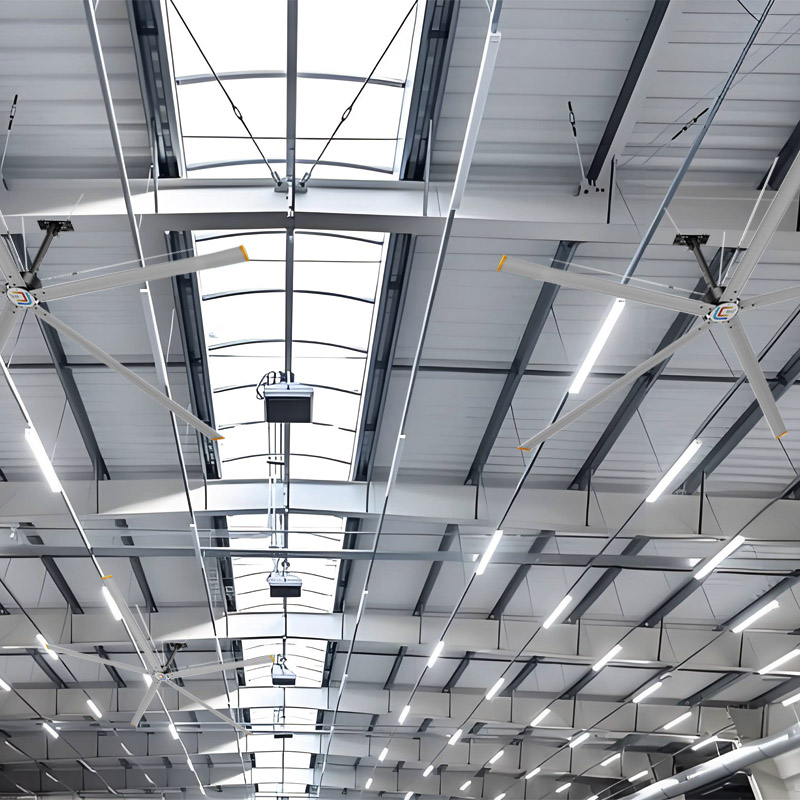
The energy-saving advantages of industrial fans are first reflected in their physical parameters. A large fan with a diameter of 7.3 meters can cover an area of 1000-1500 square meters, but the rated power of its driving motor is usually only 1.5 kilowatts. Running for one hour consumes 1.5 kWh of electricity, and the cost of electricity is about 1 yuan.
Comparing the energy consumption of traditional ventilation schemes under the same coverage area: if central air conditioning is used for air supply, the power is usually between 200-500 kilowatts; If dozens of small wall mounted fans are installed, the total power added up will far exceed 10 kilowatts. Industrial fans, with their large diameter, low speed, and high-efficiency permanent magnet synchronous motor technology, have achieved a fundamental breakthrough in "small power driving large air volume", which is the physical basis for balancing comfort and energy consumption.
2、 Optimize perceived temperature and reduce reliance on high energy consuming refrigeration equipment
Comfort is not entirely determined by the ambient temperature, the perceived temperature is the indicator that workers directly perceive. When the industrial fan is running, the continuous airflow passes over the surface of the human body, accelerating the evaporation of sweat and taking away excess heat.
According to the thermal comfort theory, with a constant ambient temperature, for every 1 meter/second increase in wind speed, the perceived temperature of the human body can decrease by 2 to 3 degrees Celsius. This means that under the working conditions of 33-34 degrees Celsius in the summer workshop, when the large fan is turned on, the perceived temperature of workers can drop to 30-31 degrees Celsius, which is close to the comfortable range of human body.
The direct value of this effect is that companies can delay the time to turn on central air conditioning or only increase the set temperature of the air conditioning by 2-3 degrees Celsius during high temperature periods to maintain the same level of physical comfort. For every 1 degree Celsius increase in the set temperature of the refrigeration equipment, about 6% -8% of energy consumption can be saved. The large fan uses extremely low power input in exchange for a significant reduction in the burden of high-energy air conditioning equipment.
3、 Eliminating temperature stratification and improving the effective utilization of heating and ventilation systems
The prominent thermal problem in tall factory buildings is vertical temperature stratification. In winter, the hot air generated by equipment operation and heating systems rises to the roof due to low density, resulting in temperatures near the roof reaching 25-30 degrees Celsius, while the ground work area only has 10-12 degrees Celsius - a large amount of heating heat is "wasted" in unmanned areas.
Industrial fans have the ability to operate in both forward and reverse modes. In winter, switch to reverse mode, and the fan blades slowly "press" the hot air accumulated on the roof back to the ground working area at an extremely low speed, reducing the vertical temperature difference from the original 8-12 degrees Celsius to within 2-3 degrees Celsius. This process does not consume additional heat energy and only uses 1.5 kilowatts of electricity to activate the previously wasted rooftop heat resources, significantly reducing the operating load of the heating system.
In summer, the forward rotation mode is adopted to push the airflow downwards, accelerate the exchange of ground hot air and roof air, and cooperate with the roof air tower or exhaust fan to discharge outdoors, reducing the air conditioning cooling pressure. Through the method of "up and down exchange, balanced temperature", the large fan allows every degree of heat or cold generated by heating and cooling equipment to be largely applied to the work area where workers are located, rather than being unnecessarily dissipated into the roof space.
4、 Intelligent frequency conversion control, achieving on-demand air supply and precise scheduling
Modern industrial fans are not simply turned on, but are equipped with variable frequency speed control systems. Managers can flexibly adjust the fan speed according to the personnel density, equipment heat generation, and outdoor climate conditions at different times in the workshop
During peak production periods with high personnel density, increase the speed to enhance ventilation and heat dissipation;
During the lunch break or shift change, if the number of personnel decreases, the speed will be automatically reduced to maintain basic ventilation;
During the transitional season of spring and autumn, only low-speed operation is needed to meet comfort requirements, and the air conditioning is completely turned off.
In conjunction with the group control system, management personnel can view the operating status, real-time power, and cumulative energy consumption of each fan on their mobile phones or computers, and independently control them according to the workshop layout zoning to avoid idle power consumption in unmanned areas. This refined management upgrades energy consumption control from "extensive switch" to "on-demand precise supply".
5、 Quantitative manifestation of comprehensive benefits
Taking a heavy machinery processing plant (with an area of approximately 10000 square meters and a net height of 12 meters) as an example, compare the measured data before and after installing industrial fans:
Comfort improvement: The vertical temperature difference in the summer work area has been reduced from 11 degrees Celsius to 2.5 degrees Celsius, and the perceived temperature has decreased by about 3-4 degrees Celsius. Workers have zero complaints about high temperatures;
Energy consumption reduction: The daily average duration of air conditioning on in summer has decreased by about 65%, and the total annual energy consumption of the ventilation system has decreased from nearly 590000 kilowatt hours before the renovation to about 220000 kilowatt hours, a decrease of 62%;
Investment return: The total investment in equipment and installation is about 250000 yuan, saving nearly 300000 yuan in electricity bills annually, and the payback period is less than one year.
Conclusion
The core logic of why industrial fans can balance comfort and energy consumption in ventilation of tall factories lies in "using the right principles and methods" - it does not attempt to use a large amount of energy to combat high temperatures, but uses small amounts of energy to drive air flow, thereby maximizing the potential for natural evaporation and heat redistribution. When the three aspects of uniform airflow, elimination of temperature stratification, and reduction of burden on cooling and heating equipment are achieved simultaneously, comfort and energy conservation are no longer a problem of choosing between the two, but a positive cycle that promotes each other. For industrial plant managers, this is undoubtedly a practical choice with controllable investment, visible effects, and predictable returns.


