Steel structure factories usually have large spans and high floors, and the problem of stuffiness and heat is prominent in summer. Industrial large fans are efficient equipment for ventilation and cooling in tall spaces. When selecting, it is necessary to consider the following aspects comprehensively.
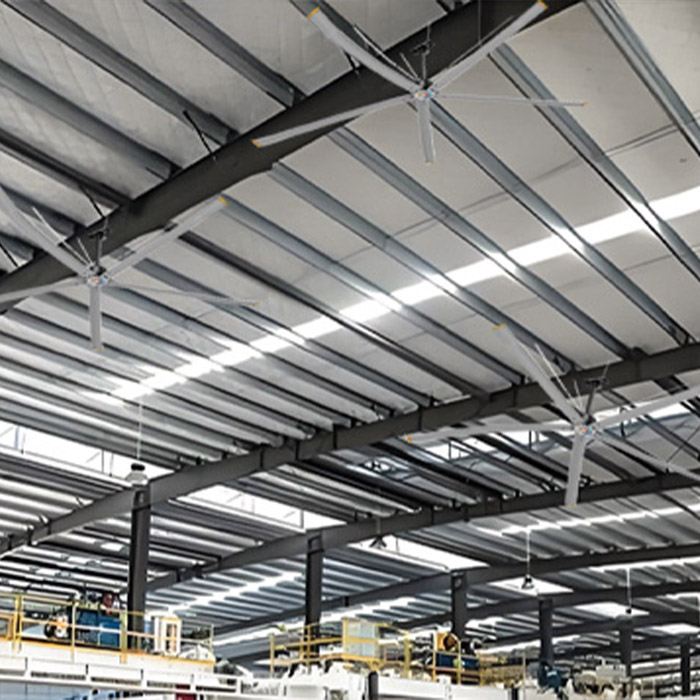
Firstly, it is necessary to clarify the usage requirements. Different factories have different demands for fans. Scenarios that prioritize ventilation and air exchange focus on air volume and coverage, while those that prioritize human body cooling place more emphasis on the comfort and noise reduction of ground air speed. Dehumidification and moisture-proof scenarios require high air circulation efficiency, while those that are used in conjunction with air conditioning require low speed and high air volume to achieve uniform airflow. Before selecting, it is necessary to clarify the area, floor height, span of the factory building, as well as whether there are any obstructions from vehicles or shelves, and the density of personnel distribution.
Next is the selection of core parameters. The diameter of the fan directly determines the coverage area and air volume. For steel structure factories with a floor height of 8 meters or more, it is usually recommended to choose a diameter of 5.5 meters or more, and the coverage radius of a single unit is about 1.5 to 2 times the diameter. In terms of air volume, large fans can reach over 100000 cubic meters per hour, and the comfortable wind speed for human body is generally maintained at 1.0 to 2.5 meters per second at a height of 1.5 meters on the ground. If the wind speed is too low, there is no cooling sensation, and if it is too high, it is easy to raise dust. In terms of motor types, permanent magnet synchronous motors are currently the mainstream recommendation due to their high efficiency, small size, maintenance free, and high low-speed torque; Asynchronous motors with reducers have lower costs but require regular maintenance; Direct drive motor without gearbox, low noise, long service life, suitable for demand. The blade material is mainly aviation grade aluminum alloy, lightweight and corrosion-resistant, and stainless steel can be selected for corrosive environments. The number of blades is usually five to eight, and the more there are, the smoother the airflow and the lower the noise. Wing shaped blades can generate greater airflow at low speeds.
The installation method also needs to be taken seriously. The common types of steel structure factory buildings include I-beam suspension, purlin installation, column side installation, and mobile type. Regardless of the method, the installation point must be able to withstand the self weight and dynamic load of the fan, usually three to five times the self weight. If necessary, the steel structure needs to be reinforced. At the same time, it is necessary to confirm the safe distance between the low point of the fan and the top of the vehicle, sprinkler head, and lighting fixtures.
Security configuration cannot be ignored. The secondary protection of steel wire rope, anti fall device, and blade anti detachment design are all indispensable. The control system is recommended to support variable frequency speed regulation, adjusting the speed according to the season and working conditions, which is both energy-saving and comfortable. The recommended protection level for motors and control systems is above IP55, and higher protection is required in humid or dusty environments. Steel structure factory buildings also need to be well grounded for lightning protection and equipotential connection.
In terms of energy efficiency and operating costs, large permanent magnet direct drive fans have a rated power of about 1.5 to 2.2 kilowatts and consume only one to two degrees of electricity per hour. One fan covers thousands of square meters and consumes only a small part of the energy of traditional air conditioners. Usually, the investment can be recovered through electricity cost savings in one or two summers.
In the selection process, first clarify the requirements, then measure the size and height of the factory building, determine the coverage area and number of units, then select the diameter and motor type, calculate the bearing capacity of the installation point, confirm the safety configuration, compare energy efficiency and price, and determine the brand and after-sales service. The estimation of the number of units can refer to the total area of the factory divided by the effective coverage area of a single unit. The effective coverage area of a single unit is approximately equal to the square of pi multiplied by 1.5 times the diameter.
Common misconceptions include only looking at the diameter without considering the air volume, ignoring the load-bearing capacity of the installation point, choosing asynchronous motors for cheap reasons, ignoring safety devices, and believing that more fans are better. The correct approach is to combine wind volume and ground wind speed to make a comprehensive judgment. It is necessary to calculate the bearing capacity of the steel structure, consider long-term electricity and maintenance costs, make secondary protection a mandatory requirement, and reasonably layout to avoid airflow interference.
In short, the core of selecting industrial large fans for steel structure factory buildings is to match space dimensions, meet ventilation and cooling needs, ensure safety and reliability, and balance energy efficiency and cost. Prioritize the selection of permanent magnet direct drive, aviation aluminum blades, products with variable frequency control and safety redundancy, and have a professional team conduct on-site survey and installation design to achieve the desired effect.


