There are essential differences between industrial fans and traditional wall mounted fans in terms of principles, effects, and applicable scenarios. Below, we will compare them from several aspects.
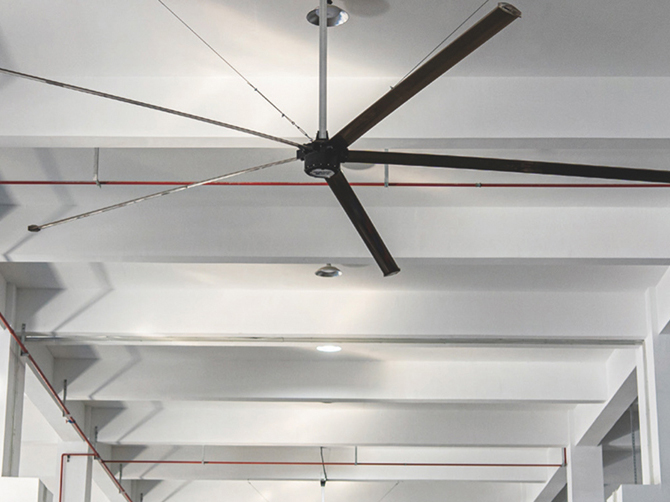
From the perspective of working principle, traditional wall mounted fans rely on small diameter blades that rotate at high speed to cut the air, generating local and high-speed turbulence. The wind sensation is concentrated but rigid, and the air supply distance is short. Industrial fans use ultra large diameter blades to rotate at low speed, pushing a large amount of air to flow as a whole, forming a three-dimensional airflow similar to natural wind, with a soft and wide coverage.
In terms of coverage area, traditional wall mounted fans typically have a coverage range of only a dozen to tens of square meters per unit, making them suitable for small rooms or local workstations. A single industrial fan can cover hundreds or even thousands of square meters, and a fan with a diameter of 7.3 meters can cover an area of over 1000 square meters, making it very suitable for tall and spacious steel structure factories and logistics warehouses.
From the perspective of wind sensation and comfort, traditional wall mounted fans have high wind speed and hard wind sensation. Long term direct blowing can easily cause discomfort to the body, and the noise is also loud. Industrial large fans have low wind speed and high air volume. The ground wind speed is usually maintained within a comfortable range of one to two meters per second, close to natural breezes, with a soft sensation and significantly lower noise.
From the perspective of energy consumption and operating costs, traditional wall mounted fans may have a small power output per unit, but they require a large number of units to cover the same area, resulting in high cumulative power consumption and wiring costs. The power of a single industrial fan is about 1.5 to 2.2 kilowatts, with an hourly power consumption of only one to two degrees, but it can cover thousands of square meters. The energy consumption per unit area is much lower than that of wall mounted fans, and the long-term operating cost advantage is obvious.
From the perspective of installation and maintenance, traditional wall mounted fans are easy to install and have low costs, but their large quantity leads to complex wiring, scattered fault points, and a large maintenance workload. Industrial large fans require professional installation and have requirements for the load-bearing capacity of the installation points, but the quantity is small and the structure is concentrated. After being equipped with permanent magnet direct drive motors, maintenance is basically free, and later management is more worry free.
From the perspective of applicable scenarios, traditional wall mounted fans are suitable for local cooling occasions such as workshops, offices, and dormitories with low floor heights and small areas. Industrial large fans are more suitable for high-rise, large-span, and widely distributed steel structure factories, large warehouses, sports venues, and other tall spaces.
From the perspective of safety and additional functions, traditional wall mounted fans have a simple structure, but with a large number and scattered installation, there are certain hidden dangers in wiring and fixation. Industrial fans are commonly equipped with secondary protection using steel wire ropes, anti fall devices, and variable frequency control, providing higher safety redundancy. They can also be used in conjunction with air conditioning to achieve uniform airflow and energy-saving auxiliary cooling.
Overall, traditional wall mounted fans excel in their low price, flexible installation, and suitability for small spaces and localized cooling; Industrial large fans excel in their wide coverage, comfortable airflow, high energy efficiency, and low maintenance, making them suitable for overall ventilation and cooling in tall spaces. For places with high floors and large areas such as steel structure factories, industrial large fans usually have advantages in comprehensive cost and effectiveness.


