The installation of large fans (ceiling fans) in factories must be based on structural safety, accurate leveling, electrical specifications, and qualified dynamic balance. Follow the following process to ensure long-term stable operation.
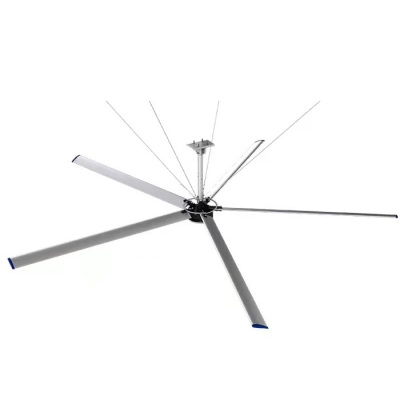
1、 Preparation before installation (key, determining safety)
1. On site survey and condition confirmation
Load bearing assessment (mandatory)
It can only be installed on concrete main beams and H-shaped steel main beams of steel structures. It is strictly prohibited to fix it on secondary beams, hollow floor slabs, color steel plates, and lightweight steel frames.
Single point static load ≥ machine weight × 3; Dynamic load ≥ whole machine weight × 1.5.
Steel structures require load proof, and concrete beams require professional testing.
Space and safety distance
The net height of the factory building is ≥ 3.5m (ideal 4-15m).
The low point of the fan blade is ≥ 2.8m above the ground.
Within the rotation range (1.2 times the diameter), there are no obstacles such as lamps, pipes, bridges, etc., and the clear distance from obstacles is ≥ 50cm.
A 5m radius warning area is set up below, and personnel are prohibited from entering during installation.
Electrical conditions
Voltage: 380V/220V, fluctuation ≤ ± 10%.
Independent circuit: equipped with leakage protector and air switch.
Cable: ≥ 3 × 2.5mm ² copper core wire with reliable grounding.
It is recommended to use 4mm ² copper core wire for a 1.5kW motor.
2. Tools and personnel
Necessary tools: high-altitude work platform/scaffold, laser level, torque wrench, multimeter, vibration tester, wire rope tension meter, safety rope/anti fall device.
Personnel: High altitude operation certificate+electrician certificate, technical briefing and safety training before construction.
3. Accessory inspection
The host, fan blades, wheel hub, bracket, shock absorber, high-strength bolts, safety cable, etc. are complete and free of deformation/cracks/rust.
Fan blade weight difference ≤ 5g/piece (dynamic balance foundation).
2、 Core installation steps (in order)
1. Positioning of suspension points and installation of brackets
Positioning: Use a laser projector to locate the center point, with a deviation of ≤ 5mm; avoid welding seams on the main beam.
Concrete beam: Use M20 rear expansion anchor bolts/chemical anchor bolts, with a hole depth of ≥ 100mm and a tensile strength of ≥ 20kN per bolt.
Steel structure: Double fixed with specialized fixtures/welding+bolts.
Horizontal calibration: The horizontal error of the bracket is ≤ 0.5 ° (laser level).
Shock absorption: Install rubber shock absorbers with a compression capacity of ≤ 10%.
2. Host lifting and fixing
Use G80 grade chains (safety factor ≥ 5) to lift the main engine.
Host and bracket connection: 8 sets of M16 (10.9 grade) high-strength bolts, symmetrically tightened in 3 times, with a final torque of 280N · m.
Secondary insurance: Install Y-shaped safety clips (2 per blade root) and 4 45 ° symmetrical safety cables (pre tension force of 500N).
3. Fan blade installation and dynamic balancing
Clean the connection surface and apply lithium grease No.2 for lubrication.
Install clockwise according to numbers 1-6 and use positioning pins to locate.
Bolt (M12 × 60, grade 8.8): initial tightening of 80N · m → final tightening of 120N · m, adding thread glue and spring washer to prevent loosening.
Dynamic balance: detected by instruments, with an imbalance of ≤ 15g · mm; Unqualified weight blocks need to be added/removed.
4. Electrical wiring (certified electrician)
Cable conduit protection, distinguish between fire/neutral/ground, and strictly prohibit mixing of neutral and ground.
Grounding resistance ≤ 4 Ω, insulation test ≥ 100M Ω.
The control box is installed in a location that is easy to operate, waterproof, and moisture-proof.
3、 Debugging and acceptance (mandatory)
static check
Manual operation of fan blades: no jamming, no friction, no abnormal noise.
Tighten all bolts to the specified torque.
No load test run (5-10 minutes)
Observe the steering and whether there are any abnormal vibrations/noises.
Vibration value ≤ 2.8mm/s (vibration meter).
load testing
Run continuously for 2 hours, check the motor temperature (≤ 70 ℃), current, and noise.
acceptance materials
Load bearing test report, installation record, torque record, dynamic balance report, debugging record.
4、 Key points of safety and maintenance
Wear double hook safety belts and fall arresters throughout the entire high-altitude operation.
Check the bolt torque, safety cable, and shock absorber monthly after installation; Perform dynamic balance retesting every quarter.
It is strictly prohibited to conduct any maintenance while the fan is running.


