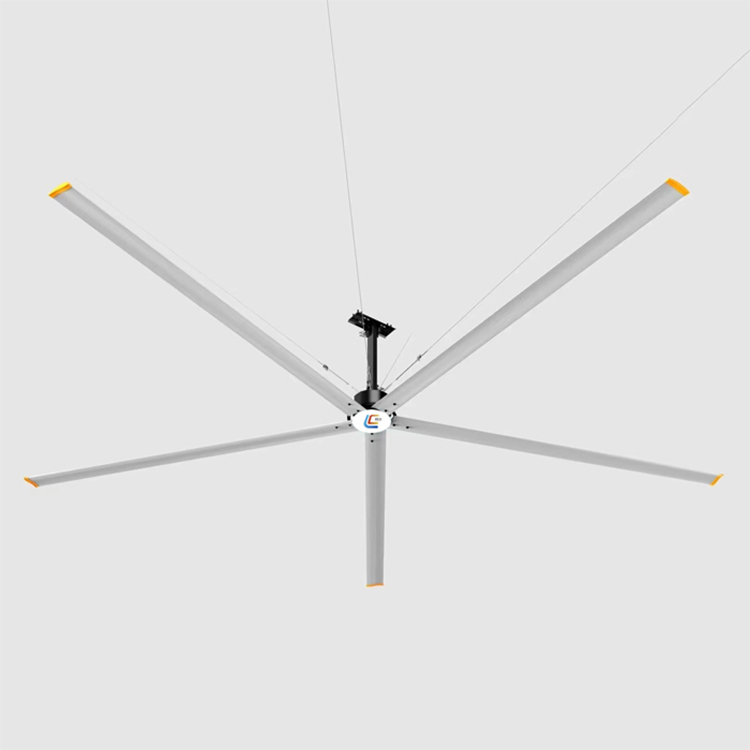
The core principle of High Volume Low Speed (HVLS) energy-saving fan is large diameter, low speed, and high torque. It uses a permanent magnet direct drive motor and aerodynamic fan blades to drive a huge amount of airflow with low energy consumption, achieving three-dimensional circulation and comfortable cooling in tall spaces.
1、 Core Composition and Power Principle
Effective Permanent Magnet Synchronous Motor (PMSM)
Efficiency of 90%+, 20% -40% higher than traditional asynchronous motors, low speed and high torque, with very low no-load losses.
Direct drive structure: no belt or gearbox, transmission loss tends to zero, low failure rate, maintenance free.
The power is only 1.1-1.5kW, covering 800-1500 square meters, and the energy consumption is 1/5-1/10 of traditional small fan groups.
Aerodynamic fan blades (5-8 pieces)
Diameter 3-7.3m, aviation aluminum alloy wing profile, variable cross-section+upturned * * 3 ° * * design.
Low drag, high lift, and increased cutting air efficiency, with an air flow rate of 10000-30000m ³/min.
2、 Principles of Airflow Organization and Circulation
Vertical downward delivery: The fan blades rotate at low speed (50-100RPM), pushing the hot air above vertically towards the ground, forming a conical main airflow.
Horizontal diffusion: After the airflow touches the ground, a 1-3m high horizontal airflow layer is formed, radiating outwards and covering a diameter range of 20-30m.
Stereoscopic circulation: When horizontal airflow encounters walls or obstacles, it rises and brings back hot air to the roof, forming a closed circulation that runs up and down, eliminating temperature stratification (hot on top and cold on bottom).
Kanda effect: The airflow closely follows the surface of the fan blades, delaying separation and reducing vortices, further improving air volume and efficiency.
3、 The underlying logic of cooling and energy conservation
Sensory cooling (3-8 ℃): A soft three-dimensional wind with a wind speed of 1-3m/s accelerates the evaporation of sweat from the skin, without any sensory cooling or discomfort from direct blowing.
Air mixing: Breaking the stratification of hot air gathering on the roof, making the space temperature uniform, and reducing air conditioning load.
Energy consumption comparison:
1 7.3m large fan: 1.5kW, covering 1500 square meters.
Traditional solution: 30-50 small fans are required, with a total power of 22.5-37.5 kW and an energy consumption difference of 15-25 times.
Energy saving of air conditioning: When combined with air conditioning, the set temperature can be increased by 2-4 ℃, and the power consumption of air conditioning can be reduced by 20% -30%.
4、 Key parameters and design points
Diameter: commonly 4.7-7.3m, the larger the coverage, the wider the coverage, and the lower the energy consumption per unit air volume.
Speed: 20-100RPM, low-speed high torque, noise * *<60dB * *, more comfortable.
Fan blade angle: installation angle of 5 ° -15 °, balancing air volume and efficiency.
5、 Summary
The energy-saving large fan is designed with permanent magnet direct drive and large diameter low-speed aerodynamics, effectively converting electrical energy into large-scale three-dimensional airflow, achieving low energy consumption, large air volume, and high comfort ventilation and cooling. It is the core solution for energy-saving renovation of high-rise spaces (factories/warehouses/venues).


